Top Stories

Grid List

FDLE Investigators, Attorney Separated from Employment

Updates appear chronologically below:


 Staff Report 1:54PM (Eastern)

ALACHUA – Criminal charges against three Santa Fe High School administrators have been formally dismissed, abruptly ending a high-profile case that unraveled after more than two years of disruption to school life at Santa Fe High.

On Jan. 9, 2026, the State Attorney for Florida’s Eighth Judicial Circuit filed a “No Information” in each case — for retired Principal Timothy Wright, former Assistant Principal David “Mac” Rendek, and Athletic Director and Title IX officer Michele Faulk — dismissing all charges before formal prosecution ever began.

The dismissals mark the collapse of a controversial prosecution initiated by the Florida Department of Law Enforcement (FDLE), which had accused the trio of violating:

  • Stat. § 39.205(1)
    Failure to Report Suspected Child Abuse – Third-Degree Felony
  • Stat. § 827.03(2)(d)
    Child Neglect Without Great Bodily Harm – Third-Degree Felony

Despite the severity of the accusations, no charges were ever brought against baseball coach Travis Yeckring, the figure at the center of the investigation. The State Attorney's decision not to proceed underscores deep flaws in the case — and raises broader questions about investigative integrity and institutional accountability.

As first reported by Alachua County Today in July 2025, FDLE’s sworn complaints leaned heavily on secondhand accounts, inconsistent witness interviews, and allegations that evolved over time.

Among the most serious accusations was that Yeckring had shown a student a “semi-nude” or “nude” photo of himself. FDLE confiscated Yeckring’s phone but never produced an image or any evidence of wrongdoing.

Alachua County Today has confirmed with sources speaking on condition of anonymity that at least three FDLE employees involved with the investigation are no longer employed by the agency.

This is a developing story, and Alachua County Today will continue to seek additional information.

#     #     #

email editor@

alachuatoday.com


UPDATE 3:29 PM (EASTERN TIME)

BELOW IS A STATEMENT FROM THE STATE ATTORNEY


BRIAN S. KRAMER STATE ATTORNEY

EIGHTH JUDICIAL CIRCUIT OF FLORIDA SERVING

ALACHUA, BAKER, BRADFORD, GILCHRIST, LEVY AND UNION COUNTIES


120 WEST UNIVERSITY AVENUE GAINESVILLE, FLORIDA 32601

clip_image004.png

TELEPHONE

(352) 374 – 3670

PLEASE REPLY TO:


MEMORANDUM TO FILE

Date:            January 7, 2026

Subject:       01-2025-CF-001853-A Defendant: Faulk, Michele Roberts

Re:              Case Closing Memorandum

Introduction

On June 19, 2025, the Florida Department of Law Enforcement (FDLE) submitted a sworn complaint alleging that the above-named defendant(s) violated Florida Statutes § 39.205 (Penalties relating to reporting of abuse, abandonment, or neglect) and § 827.03(2)(d) (Neglecting a child without causing great bodily harm, permanent disability, or permanent disfigurement).

  • Florida Statute 39.205: This statute makes it a felony of the third degree for a person who "knowingly and willfully fails to report to the central abuse hotline known or suspected child abuse, abandonment, or neglect, or who knowingly and willfully prevents another person from doing so."
  • Florida Statute 827.03(2)(d): This statute makes it a felony of the third degree for "[a] person who willfully or by culpable negligence neglects a child without causing great bodily harm, permanent disability, or permanent disfigurement to the child."

In summary, these allegations stem from the conduct of Travis Yeckring, who was at the relevant time both a baseball coach and a teacher at Santa Fe High School. It is clear from the evidence that Mr. Yeckring’s conduct was inappropriate, reprehensible, and a likely violation of school policies. FDLE alleges probable cause exists to show that Mr. Yeckring engaged in conduct with students that raised a suspicion of child abuse, and that the defendant(s) violated the above-referenced statutes by failing to report these acts. The purpose of this memorandum is to evaluate the novel legal theory of guilt proposed by FDLE to support these allegations and to determine the proper disposition of this matter.

Role of the State Attorney's Office


During any law enforcement investigation, the State Attorney's office serves in an advisory role to the law enforcement agency. The State Attorney has no authority over the investigation until the law enforcement agency files a sworn criminal complaint or makes an arrest. In its advisory capacity, the State Attorney may perform certain legal functions on behalf of the agency, such as issuing a subpoena for documents or approving a search warrant for submission to the Court. At times, the agency may informally request opinions on the legal sufficiency of a particular charge or the probability of success at trial. While practices may differ, this office generally provides such informal opinions when asked.

Investigation Background and FDLE's Position


During this investigation, the investigating officers met and communicated with this office on several occasions. As the investigation neared completion, FDLE asked for an informal opinion as to the legal sufficiency of the charges that were ultimately submitted for prosecution. During that conversation, the agents explicitly stated that Mr. Yeckring had not committed any provable criminal act.

There was no probable cause to believe that Mr. Yeckring committed an act of child abuse upon any person. The agents made it clear that no criminal case is forthcoming to this office against Mr. Yeckring for any charge.

An Assistant State Attorney, after conducting extensive legal research and internal discussions, opined that it would be both legally and practically impossible to charge any of the named defendants with a criminal act unless there was sufficient evidence to show that the defendants knew Mr. Yeckring had committed an act of child abuse against a victim, and the defendant failed to report it. The agents requested that the States Attorney’s Office conduct further research, describing Mr. Yeckring's conduct as "unlawful," though they maintained there would be no charges against him. Essentially, the agents asked that the State Attorney’s Office conduct further research because Yeckring's conduct was reprehensible and they felt that there should be a way to charge the individuals (presumably school staff/administration) for failing to report that behavior to the Department of Children and Families (DCF).

Allegations of Misconduct

Understanding the opinion expressed by the Assistant State Attorney, FDLE submitted a sworn complaint against the defendant(s). The complaint alleges that Mr. Yeckring was the baseball coach at Santa Fe High School and the investigation, in its broadest terms, concerned allegations of inappropriate, and perhaps sexual, activity between Mr. Yeckring and several female students.

This type of matter would normally fall within the purview of either the City of Alachua Police Department or the Alachua County Sheriff’s Office. While FDLE has jurisdiction, when FDLE investigates conduct of this nature, it is normally because the local agency has requested FDLE’s intervention. Here, there was no such request. Nonetheless, FDLE's investigation concluded that Mr. Yeckring committed the following acts (the State Attorney’s office accepts these allegations as true for the purpose of this memorandum):

The FDLE complaint alleges the following acts by Mr. Yeckring:

  • Communication: Communicated with female students on social media.
  • Awkwardness: Engaged in conversations with female students that resulted in the student feeling “awkward.”
  • Staring: Inappropriately stared at female students.
  • Relationships: Engaged female students in conversations regarding the status of their romantic relationships.
  • Inappropriate Photos: Showed female students pictures of:
    • His dog(s).
    • His dog(s) with him in the picture.
    • Himself without a shirt.
    • Himself shirtless with a towel covering his lower body.
  • Proximity: Stood too close to female students.
  • "Flirty" Messages: Sent a direct message to a female student over social media that was “flirty,” understood as demonstrating a romantic interest.
  • Flirty Message (Graduate): Sent a "flirty" direct message to a recent 18-year-old graduate of SFHS.
  • Compliments: Told a female student that she was beautiful, unique, and unlike other students.
  • Gifts: Purchased food for female students.

·       Interaction with One Student:

  • Consoled her over a fight with her boyfriend.
  • Told her that there were “real men” waiting in the world for her.
  • Stated to the student that he was available to
  • Grabbed her hands without permission to hold hands with her.
  • Attempted to hug the student but did not when the student indicated an unwillingness.
  • Inappropriate Comments: Commented on a female student’s underclothing.

·       Invitations:

  • Invited a female student to his residence to see his dog.
  • Invited and then cajoled a female student to accompany him off campus to a coffee shop across from SFHS, encouraging a student to violate a school rule.
  • Loitering: Would loiter in the dean’s office for no school-related reason to speak with female students assigned as office aides.
  • General Compliments: Complimented female students on their appearance and dress.
  • Tennis Offer: Offered to coach a female student in tennis (Mr. Yeckring does not play tennis) and asked to engage her in a private game; she declined.
  • Skirting Comment: Commented on the inappropriate length of a female student’s tennis skirt.
  • Unnecessary Escort: Unnecessarily and repeatedly accompanied a female student office aide while she delivered leave slips around the school.
  • Nickname: Was widely referred to by students as “Pedo Yeck,” presumably a shortened form of “Pedophile Yeckring.”


Legal Analysis

 Analysis of the "Suspected Child Abuse" Standard

This office agrees with FDLE that no act of child abuse, as defined by Florida law, was committed by Mr. Yeckring. This office contacted FDLE to clarify the basis for their finding of probable cause for the Florida Statutes 39.205 charge. The FDLE agents indicated that their concern was not tied to any single allegation but rather to the cumulative nature of all the incidents reported to the school administration. The agents know the exact dates, acts, and individuals involved in each alleged act of misconduct. In their view, the accumulation of these incidents should have led the administration to suspect potential child abuse and, therefore, mandated a report to DCF. FDLE acknowledged that none of the individual allegations, standing alone, would support a child abuse charge or trigger the reporting requirement.

"Child abuse" means any willful act or threatened act that results in any physical, mental, or sexual abuse, injury, or harm that causes or is likely to cause the child’s physical, mental, or emotional health to be significantly impaired.  Abuse of a child includes acts or omissions. FDLE has not charged Mr. Yeckring with child abuse and has confirmed that there is no ongoing investigation of Mr. Yeckring that could lead to such charges. Mr. Yeckring’s alleged conduct is clear and well known. His conduct with the students at issue in this matter was in all cases inappropriate, but, according to FDLE’s investigation, did not violate any Florida Statute. Under Florida Statutes 39.205, there must be either "known" or "suspected" child abuse or neglect to trigger the reporting requirement.

FDLE’s novel legal theory is that Mr. Yeckring’s pattern of conduct, or the totality of the circumstances, should have caused the defendant(s) to suspect child abuse and therefore required that the defendant(s) report this suspicion to the DCF, even when the underlying conduct was known not to constitute statutory child abuse. In evaluating this theory, the word "suspected" must be defined within this context. The dictionary defines "suspected" as "to imagine someone is guilty on slight evidence or without proof," or "to doubt the truth or likelihood of something." It implies an opinion or belief formed with little or no evidence, often based on guesswork.

In this context, it is useful to illustrate how the Florida Department of Law Enforcement’s (FDLE) proposed use of “suspected” differs from typical scenarios. Consider a child arriving at school with an injury strongly indicative of inflicted trauma, such as a patterned bruise resulting from repeated strikes by a commonly used object for corporal punishment, like a belt or cord. When questioned about the injury, the child claims it was an accident that would not realistically cause such a pattern. In this case, school officials would be justified in suspecting child abuse due to the discrepancy between the nature of the injury and the explanation provided. The inconsistency raises serious concerns about the true cause and the individual responsible for inflicting the injury, and given that the injury was inflicted, the cause of the injury and person who caused the injury would also be suspicious. In this matter, there is no suspicion because the nature of the conduct, and the identity of the person perpetrating the conduct are both well established.

For the State of Florida to assert a new theory of guilt, that theory must be supported by the law and legal precedent. Legal research conducted by this office shows no criminal case law interpreting Florida Statutes 39.205 that addresses this specific theory. A review of the Florida Standard Jury Instruction does not shed light on this theory; the relevant element of that instruction is simply that "the defendant knew or suspected child abuse occurred." This instruction does not define "suspected" in this instance, nor does it address the theory that a pattern of non-criminal conduct could be the basis of suspected child abuse.

Civil case law does provide some limited enlightenment. In an assertion of immunity from civil liability, a physician need only have a "reasonable cause to suspect" child abuse to be immune from civil liability for mistakenly reporting child abuse and causing damages. It is therefore reasonable to assume that a court’s interpretation of "suspected" in the criminal statute would be akin to "reasonable cause to suspect" child abuse. Here, the conduct of Mr. Yeckring is well known and known not to be criminal. FDLE’s theory is that known conduct which is not illegal constitutes reasonable cause to suspect child abuse. The common definition of "suspect" is rooted in the absence of evidence or proof, not in the combination of known, non-criminal facts. Based on this office’s research, there is no legal support for this new and novel legal theory. A new theory of a defendant’s guilt must be arguable under current statutes and case law. Even when facts underpin the theory, there must be law or case law that supports the State of Florida charging a crime under that theory of guilt. Here, neither statutory law nor case law supports FDLE’s theory, and, therefore, the State of Florida cannot ethically advance it in court.

Mr. Yeckring’s behavior appears to be consistent with what law enforcement would describe as “grooming” behavior. “Grooming” is defined as a deliberate pattern of behavior used by an offender to establish an emotional connection, trust, and a position of power over a victim—typically a minor or vulnerable adult—with the goal of sexual abuse or exploitation. Here, FDLE appears to be attempting to punish the defendant(s) for failing to report this behavior to DCF. Unfortunately, the Florida Legislature has been asked to address and criminalize grooming behavior and had thus far declined to do so.  Knowing that the Florida Legislature has rejected efforts to establish this behavior as criminal further inures against FDLE’s new and novel theory of the defendant’s guilt. Further, a Court is not likely to adopt this theory as valid. The rule of lenity is a legal principle used in criminal law to interpret ambiguous criminal statutes in favor of the defendant. It holds that when a law is unclear or has multiple reasonable interpretations, the courts should choose the interpretation that is most favorable to the defendant, thereby ensuring fairness in the application of the law. The most favorable interpretation here is that known conduct by a known perpetrator cannot constitute “suspected” child abuse.

Practical and Evidentiary Problems

In addition to the legal insufficiency, several practical problems exist with these charges:

  1. Date of Offense: The affidavit of probable cause lists the date of the offense as November 1, 2022. There is nothing contained in that report, or any other report, that supports a factual allegation that on or about that specific date the accumulated "suspicion" relied upon by FDLE fomented to the point of constituting the moment the defendant was legally obligated to make this report. FDLE cannot point to any specific moment in time when this cumulative effect would have been sufficient to mandate such a report.
  2. Universal Duty to Report: The duty to report extends to all mandatory reporters, including law enforcement officers who are aware that no report has been As of the date of this writing, this office’s investigation has confirmed that FDLE has never reported the "cumulative suspected child abuse" to DCF, nor has any parent of any child at issue here, nor has the Office of the State Attorney made any such report. This confirms the consensus that Mr. Yeckring’s conduct, while inappropriate, reprehensible, and a violation of school policy, was not criminal.

Conclusion of Analysis

 Therefore, this Office has determined that FDLE’s investigation of this matter has failed to establish sufficient evidence to believe that the defendant violated Florida Statutes 39.205. This Office is legally prohibited from filing any criminal charge for which sufficient evidence does not exist.

The additional charge of Child Neglect is defined as: “A caregiver’s willful failure or omission to provide a child with the care, supervision, and services necessary to maintain the child’s physical and mental health, including, but not limited to, food, nutrition, clothing, shelter, supervision, medicine, and medical services that a prudent person would consider essential for the well-being of the child.” The statute continues: “Neglect of a child may be based on repeated conduct or on a single incident or omission that results in, or could reasonably be expected to result in, serious physical or mental injury, or a substantial risk of death, to a child.” The basis of the alleged allegation of Child Neglect here is that knowing that Mr. Yeckring had committed these acts (which were determined not to be child abuse), the defendant failed to protect the children from Mr. Yeckring’s future acts (which were also determined not to be child abuse). The legal analysis for the child neglect charge is inextricably intertwined with the failure to report analysis; therefore, it will not be restated in this memorandum. Accordingly, these allegations fail to meet the statutory requirement for Child Neglect.

Conclusion

The core legal issue in this case is whether the cumulative effect of Mr. Yeckring's inappropriate conduct, while not rising to the level of a single, provable criminal act of child abuse, was sufficient to trigger the mandatory reporting requirements under Florida law for the defendant(s). The relevant statutes criminalize the failure to report known or suspected child abuse, not merely general workplace misconduct or violations of school policy, however unprofessional or reprehensible. Here there is no known or suspected child abuse. Given FDLE's explicit acknowledgment that no probable cause exists to charge Mr. Yeckring with an underlying act of child abuse, the State Attorney's office concludes that the essential element of "known or suspected child abuse" necessary for the prosecution of the defendant(s) under FS 39.205 and FS 827.03(2)(d) is legally insufficient. Therefore, this office will not be moving forward with the prosecution of the named defendant(s) based on the current evidence and legal theory provided by FDLE, and the case will be closed.


 

Photo special to Alachua County Today

Local

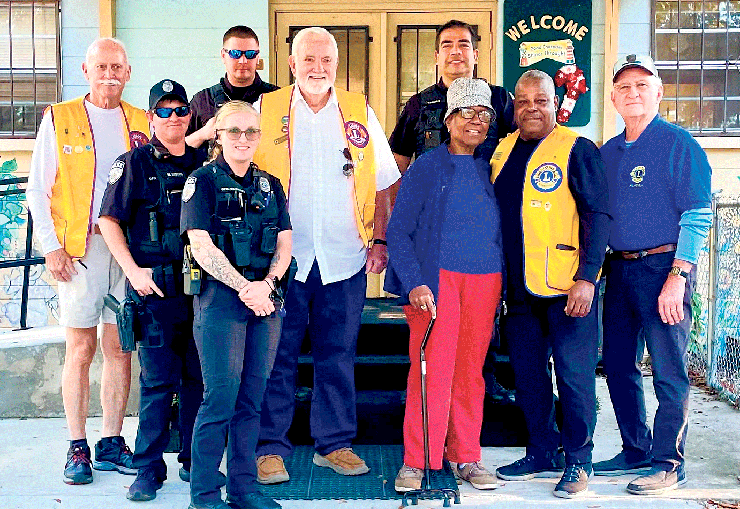
ALACHUA – Members of the Alachua Lions Club joined forces with the Alachua Police Department to spread holiday cheer in the days leading up to Christmas, packing and delivering five large boxes of food to five local families in need. The effort, organized and shared by Lions Club member Gib Coerper on Dec. 21, 2025, included not only pantry staples but also a fresh holiday ham for each family.

Photos show Lions Club members working together inside the Lions Club building to prepare the donations, followed by deliveries made with the help of Alachua police officers, who assisted with transportation and outreach. The collaborative effort reflects a long-standing tradition of community service by the Lions Club and highlights the positive role of local law enforcement in supporting charitable initiatives.

“This was truly a team effort,” Coerper noted, thanking both the Lions Club volunteers and the Alachua Police Department for helping ensure the donations reached families in time for the holidays. The event underscored the spirit of giving and cooperation that defines the Alachua community during the Christmas season.

#     #     #

email editor@

alachuatoday.com

ALACHUA COUNTY – Beginning Jan. 3, 2026, Alachua County residents will have a new option for reducing household waste as the county launches a year-long food waste collection pilot at its Rural Collection Centers.

The program, which will run through Dec. 31, 2026, allows residents to drop off food scraps for composting rather than sending them to the landfill. The initiative is a partnership between Alachua County and O-Town Compost and is funded through a Circular Economy Grant.

County officials say the pilot is designed to reduce landfill waste while creating a useful end product. Food waste collected through the program will be processed into compost that can be used by farmers, gardeners, landscapers, and other agricultural or land-use operations.

“Food waste makes up a significant portion of what ends up in landfills,” county officials noted in announcing the program. “By diverting that material into composting, the county can reduce environmental impacts while supporting local food and agricultural systems.”

The food waste drop-off will be available at all five of the county’s Rural Collection Centers:

  • Alachua/High Springs — 16929 NW U.S. Highway 441
  • Archer — 19401 SW Archer Road
  • Fairbanks — 9920 NE Waldo Road
  • North Central — 10714 N State Road 121
  • Phifer — 11700 SE Hawthorne Road

All Rural Collection Centers are open Monday, Tuesday, Friday, and Saturday from 7:30 a.m. to 5:30 p.m. The Alachua/High Springs location also offers additional hours on Wednesdays and Thursdays from 12:30 p.m. to 5:30 p.m.

The pilot program is limited to residential food waste and is intended as a test to evaluate participation levels, operational needs, and overall impact before any potential expansion. County officials will use data gathered during the year-long trial to determine whether the program should become permanent or be expanded to additional locations.

Residents seeking more information about the program can contact Patrick Irby with the Alachua County Solid Waste and Resource Recovery Department at 352-338-3233 or by email at This email address is being protected from spambots. You need JavaScript enabled to view it..

Individuals with disabilities who require accommodations to participate in a county program, service, or public meeting may contact the Alachua County Equal Opportunity Office at 352-374-5275 at least two business days in advance. TTY users may call 711 through the Florida Relay Service.

#     #     #

email editor@

alachuatoday.com

NEWBERRY – A 22-year-old Newberry man was arrested early Saturday and charged with attempted homicide after a woman was allegedly beaten inside a Newberry apartment, according to the Alachua County Sheriff’s Office.

Deputies responded at 2:16 a.m. Saturday, Dec. 20, 2025, to the Vanguard Apartments, where a deputy reported hearing a faint cry for help while checking the area. Moments later, the victim ran from an apartment yelling for assistance before collapsing on the ground, the arrest report states.

The deputy reported that the woman was actively bleeding from her head, covered in blood and limping. She had extensive bruising and scratches and said she had been in and out of consciousness.

Inside the apartment, deputies reported finding Jayce Benjamin Timmons standing in the hallway with blood on his pants and shoes but no obvious injuries.

According to the report, the victim said Timmons punched her earlier in the night at a restaurant. She returned home without him, but he later followed her and entered the apartment using a key he had taken without her consent. The victim said Timmons took her car key and snapped it, preventing her from leaving.

The victim told deputies that after an argument, Timmons began striking her with his closed fist and kicking her. She reported that he said he did not care if she died and later told her he was going to kill her.

She said the assault stopped when a deputy rang the doorbell, at which point Timmons allegedly said, “Oh, look, they came to save you; now I’m going to go to prison.” The victim told deputies she believed Timmons intended to kill her and would have succeeded had law enforcement not arrived. She said she scratched him so he could be identified if he killed her.

After being advised of his Miranda rights, Timmons reportedly told deputies the victim was “acting crazy” when he arrived at the apartment. He said he did not know where the blood on his pants and shoes came from or how the victim and apartment became covered in blood. Deputies observed blood on Timmons’ hands and knuckles and scratches on his face and throat.

Timmons was charged with attempted homicide, committing a felony that could lead to death, hindering a victim’s communication with law enforcement, false imprisonment and misdemeanor property damage for breaking the car key.

His full criminal history was not immediately available, but records indicate he is on pretrial release for a hit-and-run crash in Hillsborough County and faces an Alachua County charge of driving without a valid license. A sworn complaint for domestic battery was filed against him in September 2025 but was later dropped.

Judge Julie Johnson ordered Timmons held without bail pending a hearing on a motion from the State Attorney’s Office seeking to keep him jailed without bail until trial. If the motion is denied, bail will be set at that hearing.

#     #     #

Email cwalker@

alachuatoday.com

CROSS CREEK – A late-night vehicle fire destroyed a large barn in rural Alachua County on Sunday, Dec. 28, 2025, but quick action by firefighters prevented the blaze from spreading to nearby structures or brush, according to Alachua County Fire Rescue.

Crews from Alachua County Fire Rescue, along with Cross Creek and Windsor fire departments, were dispatched at approximately 9:37 p.m. after reports that a vehicle parked inside a barn had caught fire. Upon arrival, firefighters found the vehicle fully involved, with flames already spreading to the wooden structure.

Firefighters established a water supply using a tanker and deployed two hose lines to attack the fire. Despite the intensity of the blaze, crews were able to bring the fire under control and prevent it from spreading beyond the barn to nearby vegetation or adjacent buildings.

According to fire officials, the property owner was able to safely remove all animals from the barn before emergency crews arrived. No injuries were reported.

Photos from the scene show heavy fire involvement inside the barn, with flames consuming vehicles and equipment stored within. Firefighters worked amid thick smoke and intense heat, both from outside the structure and from inside the barn, where the roof and support trusses were heavily damaged.

The Alachua County Fire Marshal was consulted regarding the cause of the fire. Officials indicated that no further investigation will be conducted.

Alachua County Fire Rescue Fire Chief Harold Theus credited the coordinated response and rapid establishment of a water supply for preventing a larger incident.

The incident remains under review for documentation purposes, but fire officials emphasized that the outcome could have been far worse had the fire spread beyond the barn or if animals had still been inside.

#     #     #

email editor@

alachuatoday.com

HIGH SPRINGS – Santa Claus arrived early for dozens of children across North Central Florida this holiday season, thanks to a regional gift drive organized by Palms Medical Group in partnership with child advocacy organizations serving foster families.

Palms Medical Group supplied Christmas gifts for 120 children within its service area, working alongside Guardian ad Litem in Levy and Gilchrist counties and Partnership for Strong Families. The effort focused on ensuring children involved in the foster care system experienced the joy of the holiday season.

In November, wish lists from the 120 children were distributed among Palms Medical Group employees. Team members across the organization selected and purchased gifts tailored to each child’s requests, transforming individual wish lists into personalized holiday surprises.

Once all items were collected and counted, Palms’ marketing department coordinated the delivery of the gifts to Guardian ad Litem and Partnership for Strong Families during the week of Dec. 1, ensuring the presents reached children in time for the holidays.

“Seeing the impact Palms gets to make for these children is truly an event I hold close to my heart,” said Ashley Chesney, a participating Palms team member from the High Springs office. “A personal impact for myself has been reflecting on my adopted brother, especially knowing his sibling is still in foster care and might not have the same experience during this season. Knowing our staff provides such joy for all these children really brings the Christmas magic to life.”

The holiday gift initiative is one of several community-focused efforts Palms Medical Group undertakes each year as part of its mission to enhance the health and well-being of the communities it serves. Beyond the Christmas season, the organization regularly supports holiday food giveaways, back-to-school book bag distributions and a wide range of local sponsorships aimed at addressing community needs.

“The organization possesses a posture of giving with an open hand,” said Kyler Burk, director of marketing for Palms Medical Group. “What never ceases to amaze me, though, is that our team members mimic that same posture to give in the same way. Our company values not only hang on the walls, they walk the halls, the city streets and the town squares.”

Palms officials said initiatives like the holiday gift drive underscore the organization’s belief that strong communities are built through consistent engagement, compassion and partnerships that extend well beyond clinical care.

#     #     #

Email cwalker@

alachuatoday.com

TALLAHASSEE – On Dec. 18, 2025, Governor Ron DeSantis announced a total of $311 million in awards to improve infrastructure in 37 Florida communities, which includes 32 awards to rural counties and small cities. These awards come from funding through both the Community Development Block Grant-Disaster Recovery (CDBG-DR) Infrastructure Repair Program, helping communities impacted by the 2023 and 2024 Storms—Hurricanes Idalia, Debby, Helene, Milton and the 2024 North Florida Tornadoes and funding from the Rural Infrastructure Fund (RIF). These awards invest in critical infrastructure needs ranging from utility and transportation improvements to emergency operations resources in these communities—especially supporting critical water infrastructure investments across the state.

“Today in Highlands County, I was proud to announce $311 million in grant awards to improve infrastructure in 37 communities across Florida impacted by the major storms of 2023 and 2024—Hurricanes Idalia, Debby, Helene, Milton and the North Florida Tornadoes,” said Governor Ron DeSantis. “These infrastructure projects will help make Florida more prosperous, more resilient, and better prepared to weather any storms that may come our way.”

“These awards directly support job creation by providing communities with the critical infrastructure to embolden their vision for resiliency and business formation,” said Florida Secretary of Commerce J. Alex Kelly. “Whether it’s upgrading utilities, developing pad ready manufacturing sites, or improving essential services, these projects help small and rural communities attract job creators, bolster their workforce and build a thriving economic future.”

The following communities will receive funds through the 2023 and 2024 Storms Community Development Block Grant-Disaster Recovery (CDBG-DR) Infrastructure Repair Program:

 
  • Bradford County Board of County Commissioners ($5,951,403) - to structurally reinforce the roadway by adding base, pavement and re-establish the roadside swales by regrading and adding erosion protection.
  • Citrus County Board of County Commissioners ($16,435,400) – to support the replacement of a sanitary sewer system following stormwater intrusion and increased flows caused by the 2023 and 2024 storms. Upgrading these systems will expand capacity and help alleviate long-standing constraints on the county’s ability to grow, supporting future business development.  
  • City of Arcadia 
    o   $14,233,044 – to widen the main stormwater channel in the city,         providing additional storage during storms.  
    o   $8,514,000 – to construct and expand the wastewater treatment plant. 
  • City of Live Oak ($3,895,500) – to construct a 100,000-gallon water storage tank and support a water line loop project.  
  • City of Macclenny ($7,028,700) – to harden and modernize the Ohio Street Water Treatment Plant by upgrading and improving software and equipment. 
  • City of Palatka ($4,932,396) - to harden and expand the capacity of the city’s wastewater treatment plant to handle future wet weather surges. 
  • City of Wauchula ($2,386,500) – to support wastewater system repairs, rehabilitation and floodwater mitigation.  
  • Columbia County Board of County Commissioners ($4,000,000) – to upgrade and harden community shelters in Columbia County.  
  • DeSoto County Board of County Commissioners ($8,000,000) – to construct and install wells and a pumping system to connect the wastewater treatment plant to the disposal wells—providing a more secure, underground disposal method for treated wastewater.  
  • Hardee County Board of County Commissioners ($1,900,000) – to remove vegetative debris from the Peace River Waterway system. 
  • Jacksonville Electric Authority ($20,000,000) – to redirect all wastewater flows to Jacksonville Electric Authority’s existing, reliable wastewater treatment facility.   
  • Okeechobee County Board of County Commissioners ($2,720,000) – to rehabilitate, preserve and harden five critical county-owned bridges.  
  • Peace River Watershed Project ($70,000,000) – to support the water infrastructure repair project in Polk County—ensuring restoration and resiliency that manages flood risk and water quality impairment through habitat restoration.  
  • Santa Fe College ($5,000,000) – to repair and upgrade the campus gymnasium due to significant roof damage from the 2023 and 2024 Storms.  
  • Sebring Airport Authority ($3,044,630) – to demolish and replace the existing stormwater system and associated infrastructure at Sebring Regional Airport and Multimodal Logistics Center. 
  • Suwannee County Board of County Commissioners ($38,044,115) – to construct the North Florida Regional Special Needs Emergency Shelter.   
  • Town of Glen St. Mary ($1,339,500) – to harden the wastewater collection system by installing permanent standby generators for the sanitary sewer lift stations.  
  • Town of St. Lucie Village ($12,124,812) – to construct a resilient, centralized potable water supply system for the town’s public use. 
  • Union County Board of County Commissioners ($1,401,750) – to construct a hardened public safety communications tower and upgrade the county’s current emergency dispatch system.  
  • Village of Indiantown  
    o   $9,300,000 – to construct a new Reverse Osmosis water treatment plant, replacing existing outdated systems.  
    o   $7,900,000 – to replace 13,000 linear feet of the main water transmission main for the Village. 

In addition to the $400 million in IRP funding, an allotment of $50 million has been allocated by HUD to eligible counties and municipalities located in 2023 and 2024 Storms' Most Impacted and Distressed (MID) areas affected by Hurricane Ian.

The following communities will receive funds under both Hurricane Ian and the 2023 and 2024 Storms Community Development Block Grant (CDBG-DR) Infrastructure Repair Program:
 
  • City of Avon Park ($22,248,529) – to assess, evaluate, repair, sleeve or rebuild the facilities at the City of Avon Park’s Sanitary Sewer Collection System.
  • Immokalee Water and Sewer District ($10,823,000) – to improve the existing wastewater treatment plant, addressing hydraulic imbalances, enhancing treatment reliability and providing surge capacity necessary to manage extreme wet-weather inflows.
  • Town of Dundee
    o   $6,008,781 – to harden the town’s sanitary sewer collection system and install monitoring equipment at the town’s wastewater treatment plant. 
      $10,257,429 – to repair damage and harden the town’s potable water system.
 
The RIF program supports infrastructure projects that drive job creation, capital investment, and strengthen economies in Rural Areas of Opportunity (RAO), rural counties and rural communities. For Fiscal Year (FY) 2025-2026, the Florida Legislature appropriated $17 million for the RIF statewide program and $5 million for the Panhandle-Specific program for a total of $22 million. FloridaCommerce received a record 112 applications requesting more than $195 million in funding during the 2025-2026 RIF application period. Since 2019, the program has awarded more than $110 million in grant funds.

The following communities will receive funds through the Rural Infrastructure Fund Program: 

  • City of Frostproof ($238,991) – to extend an existing water main, designing a 12-inch loop allowing for extension to the area proposed as the Duke Readiness Center. 
  • City of Lake City ($1,788,415) – to replace a hangar at the Lake City Gateway Airport significantly damaged by Hurricane Idalia.  
  • City of Okeechobee ($1,200,000) – to support a construction project aimed at improving public infrastructure, facilitating expansion within an existing industrial site, including the resurfacing of two major roads that provide access to the Okeechobee Commerce Center. 
  • City of Wauchula ($510,000) – to enhance the existing water distribution system by installing approximately 7,100 linear feet of water main, enhancing fire protection along Townsend Street to U.S. Highway 17. 
  • Columbia County Board of County Commissioners ($2,000,000) – to construct an inbound and outbound rail track serving the North Florida Mega Industrial Park.  
  • Hardee County ($250,000) – to build a dewatering facility, reducing long-term disposal costs. 
  • Hardee County Industrial Development Authority ($226,250) – to continue their centralized parking construction, including the relocation of electrical utilities underground. 
  • Keystone Heights Airport Authority ($2,950,450) – to construct a runway extension to Runway 2.   
  • Okeechobee Utility Authority ($1,000,000) – to install pipe and corresponding water mains to connect previously completed water infrastructure. 
  • Putnam County Board of County Commissioners ($3,000,000) – to construct and commission critical public infrastructure at the Central Landfill in Putnam County.  
  • Town of Zolfo Springs ($300,000) – to conduct a comprehensive Sanitary Sewer Evaluation Survey which will identify infiltration and inflow sources and address challenges from power outages, lift station failures and aging infrastructure.  

#     #     #

email editor@

alachuatoday.com


TALLAHASSEE – Florida students are invited to take part in the 2025 Native American Heritage Month art and essay contests, celebrating this year’s theme: “Celebrating Florida’s Native American Heritage,” according to an announcement Thursday from the Florida Department of Education and Volunteer Florida.

Native American Heritage Month is observed nationwide each November and serves as a time to acknowledge the cultural, historical and artistic contributions of Native Americans. This year’s contests are designed to encourage students across all grade levels to explore and share stories of Florida’s Native American leaders, artists and historical figures.

“We are proud to offer students opportunities to learn from and honor the Native Americans who have shaped Florida’s story,” said Commissioner of Education Anastasios Kamoutsas. “I encourage every student to learn about our Native American history and discover the remarkable achievements they made.”

Volunteer Florida CEO Josie Tamayo echoed the message, stating, “I am proud to celebrate the culture and heritage of Native Americans who enrich the value of our Nation. During Native American Heritage Month, we honor the many contributions of Native American Floridians.”

Art Contest Details

All Florida students are eligible to participate. Students in grades K–3 may enter the art contest by submitting one original, two-dimensional piece of artwork reflecting this year’s theme. Four statewide winners will be selected, with each receiving a $200 gift card for school supplies and a one-year pass to Florida State Parks.

Essay Contest Details

Students in grades 4–12 may enter the essay contest. Six winners will be chosen—two from each grade level group (4–5, 6–8, 9–12). Each winning essayist will receive a two-year Florida College Plan scholarship from the Florida Prepaid College Foundation and a $200 school-supply gift card. Essays must be written in English, no longer than 500 words, and focus on a Native American Floridian who has had a meaningful impact on the state’s history or culture.

Examples of suggested subjects include Betty Mae Tiger Jumper, the first woman elected Chair of the Seminole Tribe of Florida; Ulele, sometimes referred to as “Florida’s Timucuan Pocahontas”; Osceola, a prominent advocate for Seminole rights in the 1800s; and Noah Billie, a noted Seminole painter.

Excellence in Education Award

The Governor’s Native American Heritage Month Excellence in Education Award is open to all full-time educators in Florida’s elementary, middle and high schools. Four winners will be selected. Nominations may be submitted by teachers, principals, parents, guardians or students. Winners will receive $2,500 from Volunteer Florida.

How to Enter

Contest entry forms and educator nomination forms may be submitted online or mailed to:

Volunteer Florida

Native American Heritage Month Committee

1545 Raymond Diehl Road, Suite 250

Tallahassee, Florida 32308

All entries must be received by 5 p.m. Eastern Time on Friday, Nov. 21, 2025. Additional information is available at www.floridanativeamericanheritage.com.

#     #     #

Email cwalker@

alachuatoday.com

JACKSONVILLE, Fla. —Today, Governor Ron DeSantis and First Lady Casey DeSantis announced Florida awards $30 million in grant funding to four specialty children’s hospitals in Florida to develop and improve access to clinical trials, advance treatment protocols, and discover cures for childhood cancer. Johns Hopkins All Children’s Hospital in St. Petersburg, Nemour’s Children’s Hospital in Orlando, Nicklaus Children’s Hospital in Miami, and Wolfson Children’s Hospital in Jacksonville were each awarded $7.5 million.

“Since I became governor, Florida has invested more than $1 billion in cancer research and treatment—a 114% increase. We created the Cancer Connect Collaborative Research Incubator program within the Florida Department of Health this year to enhance cancer research throughout Florida,” said Governor Ron DeSantis. “Four of Florida’s top children’s hospitals have received a total of $30 million in funding for their innovative proposals to help children and adolescents who are fighting cancer. By investing in statewide infrastructure for pediatric cancer initiatives, we aim to eliminate the need for Florida families to travel out of state for potentially life-saving experimental therapies and specialized care.”

The Cancer Connect Collaborative Research Incubator was created in 2025 to further Florida efforts as a leader in cancer research and treatment. The Incubator is funded with $30 million and will focus on pediatric cancer in its first five-year funding cycle. While pediatric cancer accounts for just one percent of cases nationally, Florida’s pediatric cancer population is significant, with the state accounting for six percent of all new pediatric cancer cases in the U.S., thereby impacting thousands of children and families every year.

“Research Incubator investments to advance research, prevention, and treatment for pediatric cancer represents a meaningful step forward in our mission to improve outcomes, strengthen families, and ensure that every child has access to the most advanced care possible right here in Florida,” said First Lady Casey DeSantis. “I’m deeply grateful to Governor DeSantis for his unwavering leadership and commitment to advancing cancer research in Florida.”

“Thanks to the vision and leadership of First Lady Casey DeSantis, Florida continues to set the national standard for advancing adult and childhood cancer research and care,” said State Surgeon General Dr. Joseph A Ladapo. “Through the Cancer Connect Collaborative Research Incubator, we’re not only investing in science—we’re investing in hope for children and families across the state.”

The Incubator is part of Florida’s Cancer Connect Collaborative, an innovative model designed to accelerate research, share best practices, and turn data into actionable results. Guided by five pillars—Data, Best Practices, Innovation, Honesty, and Funding—the initiative brings together public and private partners to reshape cancer care delivery.

“Thanks to the leadership of First Lady and Governor DeSantis, Florida continues to make cancer research and treatment a top priority,” said Agency for Health Care Administration Secretary Shevaun Harris. “The Cancer Connect Collaborative Research Incubator is a bold step forward, beginning with pediatric cancer research. We look forward to seeing the strides made among the awardees and the collaboration that will accelerate breakthroughs, improve access to therapies, and offer hope to families across our state.”

#     #     #

email editor@

alachuatoday.com

~ 24 of 26 economic development awards will go to small and rural communities ~
TALLAHASSEE, Fla.—Today, FloridaCommerce announced the award of more than $1.5 million through the Community Planning Technical Assistance (CPTA) and Competitive Florida Partnership programs. The funding will support 26 Florida communities—including 24 small and rural communities—in developing and implementing plans to drive local economic growth.

“Under Governor DeSantis’ leadership, FloridaCommerce continues to support Floridians in building strong, resilient communities,” said Florida Secretary of Commerce J. Alex Kelly. “Since 2019, FloridaCommerce has awarded more than $7.6 million through the CPTA program to over 110 communities—empowering many of Florida’s small and rural communities to advance strategic economic initiatives and strengthen their local economies for future growth.”

The CPTA grant program seeks to strengthen communities through resilient, long-term economic development strategies and promotes innovative planning solutions to protect Florida's natural resources. Similarly, the Competitive Florida Partnership program supports communities in developing plans to attract new businesses and create workforce opportunities that promote partnerships, community design and a viable economy.

The following communities will receive funding through the CPTA grant program:

  • Bradford County ($75,000) – to create an Economic Development Strategy, outlining objectives, tactics, resources and marketing to promote county opportunities.
  • Opportunity Florida ($47,575) – to conduct an economic analysis study in the following rural counties: Calhoun, Franklin, Gadsden, Gulf, Holmes, Jackson, Liberty, Wakulla, North Walton and Washington.
  • Apalachee Regional Planning Council ($74,231.82) – to complete a multi-county Strategic Sites Inventory to prepare for industrial reshoring and business recruitment in Calhoun, Gadsden and Liberty Counties.
  • City of Crystal River ($75,000) – to develop a strategic and economic development plan for the city of Crystal River in Citrus County.
  • City of Keystone Heights ($60,000) – to review and update the comprehensive plan for the city of Keystone Heights in Clay County.
  • DeSoto County ($75,000) – to update the county plan to expand investment and tourism opportunities.
  • Central Florida Regional Planning Council ($75,000) – to create the Heartland Agricultural Land Use Conversion Study to enhance planning, coordination, and resilience in the following counties: DeSoto, Hardee, Highlands, Okeechobee and Polk.
  • Town of Cross City ($75,000) – to update land development regulations and zoning atlas for the town of Cross City in Dixie County.
  • Town of Horseshoe Beach ($75,000) – to implement Phase II of the Recovery and Resilience Plan, focusing on drainage, housing, and capital projects in Dixie County.
  • Gadsden County ($75,000) – to develop a Strategic Sites Inventory to identify and prepare sites for industrial and manufacturing growth.
  • Glades County ($55,000) – to update land development regulations and create fact sheets, checklists, and revised applications.
  • Hardee County ($60,000) – to create a Mass Casualty Incident and Reunification Plan to strengthen emergency medical response.
  • Town of Sneads ($45,000) – to support the development of a downtown revitalization and development plan for the Sneads "Old Downtown" area in Jackson County.
  • City of Clermont ($50,000) – to update the city plan to guide infrastructure, economic development and tourism strategies for the city of Clermont in Lake County.
  • City of Cedar Key ($75,000) – to advance shoreline and infrastructure protection strategies for the city of Cedar Key in Levy County.
  • Town of Greenville ($48,500) – to conduct a housing analysis and update economic and comprehensive plans for the town of Greenville in Madison County.
  • Village of Indiantown ($74,275) – to finalize the inaugural plan and add an economic development element for the village of Indiantown in Martin County.
  • City of Crestview ($50,000) – to develop a Strategic Economic and Development Plan to assess workforce, land-use assets, and branding, with clear goals and implementation steps for the city of Crestview in Okaloosa County.
  • Okeechobee County ($40,400) – to update the land development code.
  • Town of Loxahatchee Groves ($75,000) – to develop a comprehensive strategy for growth and resilience for the town of Loxahatchee in Palm Beach County.
  • Town of Kenneth City ($40,000) – to create an economic development strategy to strengthen commercial corridors and small businesses for the town of Kenneth City in Pinellas County.
  • City of Fort Meade ($45,000) – to update the Community Redevelopment Plan to assess progress and set future priorities for the city of Fort Meade in Polk County.
  • City of Palatka ($75,000) ­– to advance the Gateway Redevelopment Plan for the former Port Consolidated site, ensuring sustainable reuse for the city of Palatka in Putnam County.
  • Taylor County ($75,000) – to create an Economic Development Strategic Plan.
The following communities will receive funding through the Competitive Florida Partnership grant program:
  • Franklin County ($32,930) – to develop a comprehensive economic development strategy aimed to strengthen the local economy, reduce retail leakage and increase job creation in the commercial sector.
  • Hardee County ($32,930) – to develop a master plan for the county’s Government Center and Resiliency Hub, a facility that will provide support during emergencies, acting as a central point of contact for accessing services, building community, and preparing for and recovering from disruptions.

#     #     #

email editor@

alachuatoday.com

The following is a press release provided by the University of Florida. It has been published here as received, without additional reporting or editing by Alachua County Today staff. ~ 


Oct. 19, 2025 — “On behalf of the Board of Trustees and the University, we express our full support for Athletic Director Scott Stricklin and his decision to make a change in the leadership of our football program.

Today’s news underscores our collective, continuing, and uncompromising commitment to a Gators football program that inspires pride across the University community and competes annually for national championships.

We will continue to provide the athletic department with every resource necessary to deliver on that promise.”

The following is a press release provided by the University of Florida. It has been published here as received, without additional reporting or editing by Alachua County Today staff. ~

Statement from Athletic Director Scott Stricklin:

Today I met with Coach Napier and informed him that a change in leadership of our football program would best serve the interests of the University of Florida.

On behalf of Gator Nation, I want to sincerely thank Billy and his family for their tireless commitment to the Florida Gators. Billy built a tremendous culture of accountability and growth among the young men he led each day. His organized and detailed approach had a meaningful impact across all levels of our program.

As Coach Napier has often said, this is a results-driven business, and while his influence was positive, it ultimately did not translate into the level of success we expect on the field.

I have named Billy Gonzales as the interim head coach. Coach Gonzales has been a valued member of our program for many years, including being a part of multiple championship teams. He is a Gator through and through. His deep understanding of our culture, our student-athletes, and what it means to represent the University of Florida makes him well-suited to lead our team.

Making this decision during the open date provides our team valuable time to regroup, refocus, and prepare for the challenges ahead. The timing also allows us to conduct a thoughtful, thorough, and well-informed search for our next head coach. We remain fully committed to utilizing every resource available to identify the right leader to guide Gators Football into the future.

I will conduct the search with a high degree of confidentiality to protect the privacy of those involved. The search will focus on the hiring of an elite football coach who will embody the standard we have at the University of Florida, and we will continue to provide all of the necessary resources for that coach, his staff and the players to be successful.

Any time you conduct a head coaching search, especially for a high-profile sport like football or men's basketball, you learn something. The lessons from past experiences will guide us through the work ahead.

Across the University of Florida, there is an unwavering and uncompromising commitment to being the best in everything we do. This includes our athletic department, as evidenced by the fact UF is the only school in the country to win three national championships in both football and men's basketball.

The standards and expectations for Gators football are to win championships-not simply to compete. We exist to win, and will not settle for less.  UF has never been more invested in the success of this football program - elite facilities, robust NIL opportunities and comprehensive support for our student athletes and staff - than we are today.

The University of Florida is a destination - a place where people come to achieve excellence.  With our resources, passionate fan base, and unwavering commitment, we are determined to return Gators football to championship form.  I understand and accept the responsibility to deliver a football program that reflects the greatness of this university and I thank Gator Nation for their continued support as we begin this next chapter together.

Scott Burns
Director of Football Communications
University of Florida Athletic Association
C: (812) 322-5285
FloridaGators.com<http://www.floridagators.com/>

William Garst HSEveryone taking prescription medications should be aware of essential safety practices. Here are six tips to help ensure you are taking your medicine correctly and safely:

1. Maintain a Comprehensive Medication List

Keep an up-to-date list of everything you take, and share it with every healthcare provider you see (doctors, specialists, dentists, and pharmacists).

  • Include: All prescription drugs, over-the-counter (OTC) medications, vitamins, herbs, and dietary supplements.
  • Detail: The name, dosage, how often you take it, and the reason it was prescribed.
  • Why it matters: This is the most crucial step to prevent dangerous drug-to-drug interactions, to ensure you don't accidentally overdose on two products with the same active ingredient, and to help your doctor avoid prescribing medicine you shouldn't take.

2. Know the "Five W's" of Each New Drug

Before you leave the doctor's office or the pharmacy, make sure you know the following for every new prescription:

  • What is the name of the drug and what is it for?
  • When should I take it (e.g., morning, night, with food, on an empty stomach)?
  • What are the most common side effects, and when should I call the doctor?
  • What foods, drinks (like alcohol or grapefruit juice), or other medications should I avoid?
  • Why am I taking this (What is the goal of the therapy)?

3. Take Your Medication Exactly as Prescribed

Consistency is key to the drug's effectiveness and your safety.

  • Follow Directions: Take the exact dose at the exact time(s) specified. Do not skip doses, and never take a larger dose because you think it will work faster.
  • Do Not Stop Early: Finish the full course of a prescription (especially antibiotics), even if you start to feel better. Never stop taking a maintenance drug on your own; always consult your doctor first.
  • Ask Before Modifying: Do not crush, cut, or chew tablets unless your pharmacist or doctor specifically says it is safe, as this can affect how the drug is absorbed or release the medicine too quickly.

4. Use a Single Pharmacy

Whenever possible, fill all your prescriptions at the same pharmacy.

  • Interaction Check: This allows your pharmacist—who is a medication expert—to have a complete and centralized record of your profile and automatically check for potential drug interactions or dosage conflicts.
  • Ask Questions: Your pharmacist is your best resource for practical advice on when and how to take a medication and what common side effects to expect.

5. Store and Dispose of Medication Safely

Improper storage can ruin the drug's effectiveness, and improper disposal can lead to danger.

  • Storage: Keep most medications in a cool, dry place, away from heat and direct sunlight. The bathroom medicine cabinet is often too humid for proper storage.
  • Security: Always store medications, especially controlled substances and pain relievers, in a secure place out of reach and out of sight of children, pets, and visitors.
  • Disposal: Never flush medicine down the toilet or throw it in the trash unless the label specifically instructs you to. Find a drug take-back program or a community disposal site (often at local police departments or pharmacies) for safe disposal of unused or expired drugs.

6. Never Share or Borrow Prescription Medication

Medications are prescribed based on an individual's specific medical condition, weight, allergies, and other concurrent medications.

  • For You Only: Never take medicine prescribed to another person, even if you have the same symptoms. What is helpful for one person could be dangerous or deadly for another.
  • Do Not Share: Never give your prescription to a family member or friend. If you have unused medication, dispose of it safely.

Prosper and be in health.

*     *     *

William Garst is a consultant pharmacist who lives in Alachua, Florida. He is semi-retired and works part time at Lake Butler Hospital in Lake Butler, Florida. William received his pharmacy degree at Auburn University and a Doctor of Pharmacy from Colorado University. The Pharmacy Newsletter is a blog where you can find other informative columns. He may be contacted at This email address is being protected from spambots. You need JavaScript enabled to view it..

#     #     #

Email editor@

alachuatoday.com

Sept 15 – Oct. 15 is the nationwide celebration of Hispanic Heritage Month. This year’s theme is “Collective Heritage: Honoring the Past, Inspiring the Future,” reminding us that our nation’s strength comes from the diverse people who call it home and the shared commitment to build a better future together.

From the arts and education to business and public service, Hispanic Floridians continue to enrich every aspect of life in our state. Their leadership, creativity, and dedication exemplify the power of community and the enduring belief that opportunity should be within reach for all.

The Florida Commission on Human Relations’ (FCHR) mission is to promote equal opportunity and prevent discrimination by investigating allegations of discrimination in housing, public accommodations, employment, and state whistleblower retaliation as well as educating Floridians about their rights and opportunities. Through our diligent work, we continue to build a Florida where everyone is treated with dignity and respect. For more information or to file a complaint, contact the Florida Commission on Human Relations at (850) 488-7082 or visit www.FCHR.MyFlorida.com.

This month, and throughout the year, we honor the past while inspiring the future, by recognizing the collective heritage that connects us, celebrating the diversity that strengthens us, and reaffirming our commitment to fairness for every Floridian.

Cheyanne Costilla, Executive Director

Florida Commission on Human Relations

The history of vitamin K is a story of a single discovery that later expanded to include a family of related compounds, each with distinct roles in the body. The journey from initial observation to a detailed understanding of vitamin K1 and William Garst HSK2 spans several decades and involves multiple scientists.

The Initial Discovery of Vitamin K

The story begins in the late 1920s with Danish biochemist Henrik Dam.

  • 1929: Dam was conducting experiments on chickens, feeding them a diet that was deficient in cholesterol and fat. After a few weeks, he noticed that the chickens developed a mysterious bleeding disorder, where their blood was slow to clot.
  • 1935: Dam concluded that a new, fat-soluble vitamin was missing from the chickens' diet. He named this substance “Koagulations-Vitamin,” which is German and Danish for “coagulation vitamin.” This is where the letter “K” comes from.
  • 1939: American biochemist Edward Doisy and his team at St. Louis University isolated and determined the chemical structure of the primary plant-based form of the vitamin, which they named phylloquinone. This substance would later be officially named Vitamin K1.

For their work on the discovery and chemical nature of vitamin K, Dam and Doisy were jointly awarded the Nobel Prize in Physiology or Medicine in 1943.

Vitamin K1 (Phylloquinone)

  • Source: From the very beginning, it was clear that the "anti-hemorrhagic" factor came from plant sources, particularly green, leafy vegetables like spinach and kale.
  • Function: Early research, and the Nobel Prize, focused on its essential role in blood coagulation. Vitamin K1 acts as a crucial cofactor for an enzyme that "activates" several clotting factors in the liver, including prothrombin (Factor II), Factor VII, Factor IX, and Factor X. Without this activation, these proteins cannot function properly, leading to uncontrolled bleeding.
  • Modern Understanding: Vitamin K1's role in blood clotting remains its most well-known and clinically important function. It is used medically to treat bleeding disorders, and is routinely given to newborns to prevent a condition called Vitamin K Deficiency Bleeding (VKDB).

Vitamin K2 (Menaquinones)

The story of vitamin K2 is more recent and has led to a re-evaluation of the entire vitamin K family.

  • Discovery of a Second Form: Soon after the discovery of vitamin K1, scientists realized that there was another form of vitamin K. This second form, found in animal products and produced by bacteria, was chemically different. It was named menaquinone and collectively referred to as Vitamin K2. Unlike K1, which has a single chemical structure, K2 is a family of related compounds, designated as MK-4, MK-7, MK-9, etc., based on the length of their side chain.
  • Japanese Fermented Foods: A major breakthrough in the understanding of K2 came from research into the traditional Japanese food natto, a dish of fermented soybeans. Scientists discovered that natto was an incredibly rich source of a long-chain menaquinone, specifically MK-7. This led to a boom in research on K2's health benefits.
  • Beyond Blood Clotting: While K1 is primarily used by the liver for blood coagulation, researchers found that K2 has a different fate in the body. It is preferentially used by other tissues, especially bone and arterial tissues.
  • The “Calcium Paradox”: A key aspect of modern K2 research is its role in “calcium trafficking.” Scientists have discovered that K2 activates proteins like osteocalcin in bones, which helps bind calcium and integrate it into the bone matrix. At the same time, K2 activates Matrix Gla Protein (MGP), a protein that prevents calcium from building up in soft tissues like arteries. This led to the theory that K2 may play a significant role in both bone health (preventing osteoporosis) and cardiovascular health (preventing arterial calcification).

Summary of Key Differences and Modern Research

Feature

Vitamin K1 (Phylloquinone)

Vitamin K2 (Menaquinones)

Primary Source

Green leafy vegetables

Fermented foods (natto, cheese), animal products (egg yolks, some meats), and gut bacteria

Primary Function

Blood coagulation (clotting)

Bone health, cardiovascular health (preventing arterial calcification)

Historical Focus

The first form of the vitamin discovered; initial research focused entirely on this form for its anti-hemorrhagic effects.

A later discovery, with its distinct functions only becoming widely known and studied in the last few decades.

Chemical Structure

A single compound (phylloquinone)

A family of compounds (menaquinones), denoted as MK-4, MK-7, etc.

The history of vitamin K is a testament to how scientific understanding evolves. What began as a single discovery of a “coagulation vitamin” has expanded to encompass a complex family of nutrients with far-reaching effects on human health.

Prosper and be in health.

*     *     *

William Garst is a consultant pharmacist who lives in Alachua, Florida. He is semi-retired and works part time at Lake Butler Hospital in Lake Butler, Florida. William received his pharmacy degree at Auburn University and a Doctor of Pharmacy from Colorado University. The Pharmacy Newsletter is a blog where you can find other informative columns. He may be contacted at This email address is being protected from spambots. You need JavaScript enabled to view it..

#     #     #

Email editor@

alachuatoday.com

~ The First Recorded Clinical Trial in 1747 ~

The history of Vitamin C is closely linked to the understanding and eventual conquest of scurvy, a debilitating and often fatal disease that William Garst HSplagued sailors on long voyages for centuries.

Early Observations

As early as the 15th century, it was noted that certain foods, particularly citrus fruits, had a curative effect on scurvy. Vasco da Gama's voyages, for instance, observed this link.

In 1747, James Lind, a British naval surgeon, conducted a controlled experiment demonstrating that citrus fruits effectively prevented scurvy. He compared various treatments among sailors with scurvy and found that only those receiving oranges and lemons recovered. This is perhaps, the first recorded clinical trial.

Despite Lind's groundbreaking work, it took several decades for the British Navy to mandate citrus fruit or juice as a regular provision for sailors, earning them the nickname “limeys.”

The Dawn of Vitamin Research:

In 1912, Casimir Funk introduced the concept of “vitamins” as essential dietary components. The anti-scorbutic factor was soon recognized as a water-soluble substance, initially called “water-soluble C.”

Isolation and Identification:

In 1928, Hungarian scientist Albert Szent-Györgyi isolated a substance from animal adrenal glands, naming it “hexuronic acid.” He suspected it might be the anti-scorbutic factor.

Around the same time, in 1932, American biochemist Charles Glen King also isolated vitamin C in his laboratory and concluded it was the same as Szent-Györgyi's hexuronic acid. There was some dispute over who made the definitive connection first, possibly due to communication delays.

Working independently, Szent-Györgyi and his colleague Joseph Svirbely conducted experiments on guinea pigs (which, like humans, cannot synthesize vitamin C) and proved that hexuronic acid was indeed the anti-scorbutic factor. They renamed it “ascorbic acid,” meaning “anti-scurvy.”

Structural Determination and Synthesis:

In 1933, British chemist Norman Haworth determined the chemical structure of vitamin C. Haworth and Szent-Györgyi jointly proposed the name “ascorbic acid”

Both Szent-Györgyi and Haworth were awarded Nobel Prizes in 1937 for their work on vitamin C. Szent-Györgyi received the Nobel Prize in Physiology or Medicine for his discoveries concerning biological combustion, with specific reference to vitamin C, and Haworth received the Nobel Prize in Chemistry for his work on the constitution of carbohydrates and vitamin C.

Further Discoveries and Applications:

Szent-Györgyi continued his research, famously identifying paprika as an exceptionally rich and easily accessible source of vitamin C, allowing for its production in larger quantities.

Since its discovery, vitamin C has been extensively studied for its various roles in human health, including its function as an antioxidant, its involvement in collagen synthesis, immune function, and iron absorption.

Today, vitamin C is recognized as an essential nutrient, and its deficiency is known to cause scurvy, characterized by symptoms like weakness, bleeding gums, and poor wound healing.

Research continues to explore the potential benefits of vitamin C in preventing and treating various diseases.

The history of vitamin C is a compelling story of scientific investigation driven by the need to combat a devastating disease. From empirical observations to isolation, structural determination, and synthesis, the journey to understanding and utilizing this essential nutrient has significantly impacted human health

*     *     *

William Garst is a consultant pharmacist who lives in Alachua, Florida. He is semi-retired and works part time at Lake Butler Hospital in Lake Butler, Florida. William received his pharmacy degree at Auburn University and a Doctor of Pharmacy from Colorado University. The Pharmacy Newsletter is a blog where you can find other informative columns. He may be contacted at This email address is being protected from spambots. You need JavaScript enabled to view it..

#     #     #

Email editor@

alachuatoday.com

As a concerned citizen of Florida, I am writing to express my deep alarm over the recent decision to eliminate all vaccine mandates in our state. Vaccines have long been one of the most effective and life-saving public health tools we have. Rolling back these protections threatens to reverse decades of progress against diseases like measles, mumps, and polio — illnesses that vaccines had nearly eliminated.

This decision will not affect all Floridians equally. Black and Brown communities, already facing disproportionate rates of chronic illness, limited access to care, and systemic health inequities, will bear the heaviest burden. Without the safeguard of mandates, these communities are at greater risk of disease outbreaks and preventable deaths.

I am also concerned about the issue of trust. Our nation’s history of medical neglect and mistreatment of Black and Brown populations has left a deep scar of mistrust in the healthcare system. Abrupt policy changes such as this risk eroding fragile progress in building confidence and could reinforce skepticism toward public health guidance.

Beyond the health risks, there are serious financial and economic consequences. Preventable outbreaks lead to increased healthcare costs, hospitalizations, and strain on already overburdened medical systems. Families who cannot afford time off work or unexpected medical bills will be disproportionately harmed. Local businesses and schools may also face disruptions if vaccine-preventable diseases reemerge, causing lost productivity and economic instability. In short, what may appear to be a rollback of regulation could instead create higher costs for families, communities, and the state as a whole.

While individuals should have the right to make informed decisions — including the ability to opt out under certain circumstances — public health policy must balance personal choice with the protection of children, immunocompromised individuals, and entire communities. Without mandates or robust equity-driven alternatives, our most vulnerable neighbors will be left unprotected.

Faith and cultural values are also central to many families’ health decisions. Public health efforts should engage and respect these perspectives. But removing mandates outright, without strong outreach, education, and access initiatives, will send us backward — leaving communities exposed to diseases that science has already taught us how to prevent.

I urge you to reconsider this decision. If mandates are to be removed, Florida must implement strong, equity-focused measures to ensure that every Floridian — regardless of race, income, or faith — is protected. Public health policy must be guided not only by science and fairness but also by a recognition of the enormous economic and financial strain that preventable outbreaks place on families and our state.

Roberta C. Lopez

Archer, Florida

The history of the B vitamins is a fascinating journey that spans several decades and involves the work of numerous scientists. Initially William Garst HSthought to be a single nutrient, it was later discovered to be a complex group of essential water-soluble vitamins with distinct functions. Here's a brief overview of their discovery:

The Beriberi Connection

The story begins in the late 19th Century with the investigation of beriberi, a debilitating disease prevalent in regions where polished white rice was a dietary staple.

  • 1889: Dutch physician Christiaan Eijkman, working in the Dutch East Indies (now Indonesia), observed that chickens fed polished white rice developed beriberi-like symptoms, which were reversed when they were fed unpolished brown rice. This suggested a nutritional deficiency.
  • 1906: English biochemist Frederick Gowland Hopkins proposed the existence of "accessory food factors" beyond fats, proteins, and carbohydrates that were essential for growth and health.

The “Vitamine” Concept

  • 1911: Polish biochemist Casimir Funk, working in London, isolated a substance from rice polishings that could cure beriberi in pigeons. He proposed that this and other similar substances were vital amines, coining the term “vitamine.” Although not all vitamins are amines, the name stuck (later dropping the “e”).

Distinguishing Multiple Factors

  • 1913: American biochemist Elmer McCollum distinguished between “fat-soluble factor A” and “water-soluble factor B,” recognizing that there was more than one essential nutrient in the water-soluble category.

Isolation and Identification of Individual B Vitamins:

The subsequent decades saw the isolation and characterization of the individual B vitamins:

  • Vitamin B1 (Thiamin): Isolated in crystalline form in 1926 by Dutch chemists Barend Jansen and Willem Donath. It was the first B vitamin to be identified and was found to be the anti-beriberi factor.
  • Vitamin B2 (Riboflavin): First observed as a yellow-green fluorescent pigment in milk in 1872, it was characterized and named riboflavin in the early 1930s.
  • Vitamin B3 (Niacin): Its deficiency was linked to pellagra in 1915 by Joseph Goldberger. The chemical structure was determined in 1937 by Conrad Elvehjem.
  • Vitamin B5 (Pantothenic Acid): Discovered in 1933 by Roger J. Williams while researching essential nutrients for yeast.
  • Vitamin B6 (Pyridoxine): Identified in 1934 by Paul Gyorgy.
  • Vitamin B7 (Biotin): Research spanned the early 1900s, with contributions from Margaret Averil Boas (1927) and Paul Gyorgy (who named it Vitamin H in 1939), among others.
  • Vitamin B9 (Folate/Folic Acid): Identified in 1933 by Lucy Wills for its role in preventing a type of anemia during pregnancy.
  • Vitamin B12 (Cobalamin): Its deficiency was linked to pernicious anemia. It was isolated in 1947 by Karl Folkers and his team.

The “B Complex”

As each water-soluble vitamin with a distinct function was discovered, they were grouped together as the “vitamin B complex.” This term reflects their shared water solubility and their common occurrence in many of the same foods, as well as their often-interconnected roles in metabolic processes.

Nobel Prizes

The importance of B vitamin research is highlighted by the Nobel Prizes awarded to scientists involved in their discovery and understanding:

  • 1929: Christiaan Eijkman and Sir Frederick Gowland Hopkins were jointly awarded the Nobel Prize in Physiology or Medicine for their work on the discovery of vitamins. Eijkman's work focused on the link between diet and beriberi (leading to the identification of Vitamin B1), while Hopkins was recognized for his broader contributions to the understanding of essential nutrients.
  • 1934: George Whipple, George Minot, and William Murphy received the Nobel Prize for their work on the treatment of pernicious anemia using liver extracts, which eventually led to the isolation of Vitamin B12.
  • 1964: Dorothy Hodgkin was awarded the Nobel Prize in Chemistry for her work on determining the structures of important biochemical substances, including Vitamin B12.

Modern Understanding

Today, we have a detailed understanding of the chemical structures, functions, dietary sources, and deficiency symptoms of each of the B vitamins. They are known to play crucial roles as coenzymes in numerous metabolic pathways, affecting energy production, nerve function, red blood cell formation, DNA synthesis, and many other vital processes.

It's worth noting that several other substances were once considered part of the B complex and assigned B numbers (like B4, B8, B10, B11), but these were later found to be either synthesized by the body or not essential and were thus removed from the official list of B vitamins

*     *     *

William Garst is a consultant pharmacist who lives in Alachua, Florida. He is semi-retired and works part time at Lake Butler Hospital in Lake Butler, Florida. William received his pharmacy degree at Auburn University and a Doctor of Pharmacy from Colorado University. The Pharmacy Newsletter is a blog where you can find other informative columns. He may be contacted at This email address is being protected from spambots. You need JavaScript enabled to view it..

#     #     #

Email editor@

alachuatoday.com

FloridaPublicNoticesSite

FlaPublicNotices

Search Florida Public Notices


National News

State
Typography

GAINESVILLE – Santa Fe College is investing an additional $500,000 in scholarships for non-traditional students to remove barriers to college enrollment and achievement. These new scholarships are in addition to the $1.5 million awarded annually by the SF Foundation. Anticipated scholarship outcomes include expanding the region's college-going culture, improving student success, and increasing economic and social mobility.  

Based on student and community feedback, the new scholarships were created to address the needs of these underserved students. In mid-April, the electronic application will open for the following new Board of Trustees scholarships:  

  1. Adult Education Scholarship: Helps community members prepare for the GED exam through the College’s Educational Opportunity Center.  
  2. Baccalaureate Scholarship: Supports community members who have already earned an associate’s degree go on to pursue a baccalaureate degree at SF.  
  3. Family Support Scholarship: Assists community members who serve as caretakers for elderly or disabled adult relatives.  
  4. Finish at the Top/Last Mile Scholarship: Supports SF students who previously stopped out but only need 12 credit hours or less to graduate.  
  5. Gap Scholarship: Assists currently enrolled SF students who need funding to complete prerequisites to transfer into the university of their choice. 
  6. Part-Time Scholarship: Provides support to community members who are unable to take a full load of classes, but are committing to earning a degree on a part-time basis.  
  7. Workforce Continuing Education Scholarship: Provides job skills and certification in preparation for employment in specific high-demand areas. Supports non-degree seeking students in the college’s Continuing Education program.   
  8. Study Abroad Scholarship: Help students participate in SF’s study abroad experiences.  
  9. International “SOS” - Student Opportunity Scholarship: Assists international students at SF on an F-1 or F-2 student visa who are experiencing a crisis beyond their control.  
  10. SF International Resident Scholarship: Assists international students with financial need who are not studying with an F-1 or F-2 student visa.  

To apply, please go to https://www.sfcollege.edu/fa/scholarships/college-scholarships/. Completion of the Free Application for Federal Student Financial Aid (FAFSA) is an eligibility component for most of the scholarships.  

In addition to these new scholarships for non-traditional students, Santa Fe College developed the SF Achieve program to foster a college-going culture in the local community. Students attending public high schools in Alachua and Bradford counties may participate in the program.  

#     #     #

Email editor@

alachuatoday.com