

• About Alachua County Today
  • Advertise
  • News
  • Community Calendar
  • Public Notices
Alachua County Today Alachua County Today

Boukari Law, P.A.

 PLACE YOUR LEGAL NOTICES HERE

08
Wed, Apr
640 New Articles
  • Home
  • Advertise-Subscribe-About Us
    • About ACT News
    • Advertise
    • Subscribe
  • Calendar
    • Calendar
    • Gov't Meetings
  • News
    • Local
    • Obits
    • Sports
  • Public Notices

Business guru travels world to spread expertise
Details
CARL MCKINNEY
Local
31 July 2013
  •  Print 
  • Email

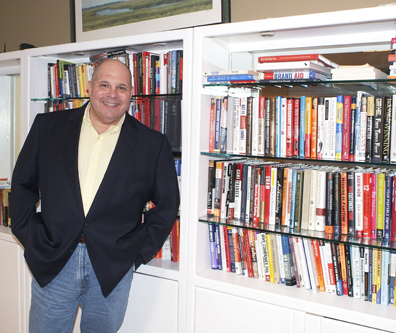
W - Sence - DSCF8136 copyJohn Spence reads over 100 business books each year to help him teach people how to be effective managers and employees in their companies.

ALACHUA – Even though he's done it countless times, he still gets nervous when he has to speak in front of a crowd.

John Spence, 49, from Newberry, has been called a motivational speaker, but he prefers the term informational speaker. From his office in the city of Alachua, he runs a business that takes him to speak in front of employees of multinational companies and local businesses alike, lecturing them on teamwork, leadership, embracing change and creating a "culture of winning." He speaks to groups of many sizes, from large crowds, to small teams and mentors individual business owners.

"I'm sort of an introvert," Spence said. "I don't really like crowds, but I do like helping people."

He still gets emails from clients he spoke to over six years ago, thanking him and his company, Flycaster & Company, for saving their business.

When he was in his early 30s, John Spence worked for a consulting company called Sales Force Systems International. He was set to be the CEO, but things didn't work out that way.

Sales Force Systems International gives sales training and consulting to businesses all over the world. In order to prepare himself as a CEO, Spence began traveling with the instructors to places like China, Germany and Japan, watching them give classes to a corporate audience. He mainly sat in the back, but eventually, the instructors asked him to help teach. He was so good at it, the current CEO decided to make him an instructor instead of a successor. Spence was unhappy with the decision at first.

"I fought it for a while," he said. "I had no desire to be a speaker."

Two things changed his mind, Spence said. The first instance was when a client in New Zealand sent him to lecture employees of giant corporations. "That is when I learned I have enough information that I could truly help these big businesses with multibillion dollar deals." The second was when he started helping the Florida Recreation and Park Association train people to direct parks and recreation departments across the state. "That's when I realized I was truly helping people."

Soon, he found a passion for the work, spending nearly three years at that company, before going independent in 1994. Fortune 500 companies and Alachua-based businesses such as Dragonfly Sushi in Gainesville and the biomedical company InterMed have called Spence in for advice on how to manage their businesses.

"What makes me good at doing this is that I'm good at seeing patterns," he said. He looks for the things that have worked for companies in the past, and finds ways to apply them, he said.

Spence is an avid reader, consuming anywhere from 100 to 120 business books per year. "I'm a voracious collector of information," he said. He credits his ability to take in massive amounts of information and learn lessons from what he reads as a driving factor in his success, which includes being named one of the 100 "Thought Leaders in Trustworthy Business Behavior 2013" by Trust Across America, which started in 2008 to "help enhance trustworthy behavior in organizations," according to its website.

The most rewarding thing for Spence is speaking to a crowd, knowing that their company will apply his ideas to improve their business, though from time to time upper management can sometimes be stubborn and refuse to acknowledge a problem, he said. It's all worth it for him when he gets emails from grateful clients, he added.

"It's nice to get paid, but there's no amount of money in the world that's worth somebody saying 'you saved my business'."

John Spence chose to base himself in Alachua County because he wanted the best of both rural and urban living, being able to drive home from Alachua to Newberry and see cows and fields, while also being able to visit museums in Gainesville. Even though he spends a good amount of time in his Alachua office answering calls from Shanghai and India and writing books, he also gets to go to faraway places like New Zealand, where he took a week off between lectures to go fly-fishing with his wife.    

"It's a way for us to enjoy seeing the world and get paid to do it."

#     #     #

Email cmckinney@

alachuatoday.com

Add a comment
Sid Martin Biotech ranked first again

Details
BRYAN BOUKARI
Local
31 July 2013
  •  Print 
  • Email

ALACHUA – For the third time this year, the University of Florida Sid Martin Biotechnology Incubator, located in Alachua, received top marks as an incubator. Sweden-based research group University Business Index (UBI) ranked the Sid Martin Biotechnology Incubator as the “World’s Best University Biotechnology Incubator” based on numerous criteria.

Conducted by UBI for the first time, the report was based on an extensive international study and analysis of 150 incubators across 22 countries.

“Being recognized as world’s top biotech incubator is especially gratifying because UBI’s rankings are data-driven,” said incubator director Patti Breedlove.

The assessment reviewed three general areas for each incubator including value for the “ecosystem” in which it operates, value for the client startups and attractiveness.

Within that framework, UBI assessed more than 50 performance indicators including economy enhancement, talent retention, access to funding, post-incubation relationships and internal environment.

“They asked for more information than I’ve ever been asked in a statistical ranking survey,” said Breedlove, noting how extensive the review was.

According to a University of Florida review of the full UBI assessment, the report found that European incubators perform substantially lower than U.S. programs, despite spending more on operations and client seed funding.

The report also reveals that European incubators provide their clients nine times as much seed funding but create 1.9 times fewer jobs and 2.8 times lower revenue per client per year.

Top incubators, like UF Sid Martin Biotech, create 2.8 times more jobs than the global average, according to the study.

“We couldn’t be more proud of the talented team at the Sid Martin Biotech Incubator. With their help, UF is producing an outstanding crop of bioscience companies,” said David L. Day, director of UF’s Office of Technology Licensing.

Breedlove also credits her team saying, “The group we have here is the best we’ve ever had,” said Breedlove. “They take a lot of pride in watching the companies grow and succeed.”

The Texas-based Alliance for Technology and Entrepreneurship was named top global incubator overall. Other top incubators by sector were Ireland’s NDR Launchpad (information technology), and New York’s UB Technology (life sciences).

The Sid Martin Biotechnology Incubator was ranked by National Business Incubation Association (NBIA) as the 2013 Incubator of the Year. NBIA also ranked Sid Martin Biotech as the top technology incubator earlier this year.

In 2007, Sid Martin Biotech was first runner-up for NBIA’s Incubator of the Year award.

Built in 1995, UF Sid Martin Biotech is one of the U.S.’s first bio-business incubators. The 40,000-square-foot bioscience complex is located at Progress Corporate Park in Alachua. The incubator’s companies and graduates have attracted more than $1 billion in equity investment, contracts, grants, and merger and acquisition activity.

University of Florida News Desk Writer Nathalie McCrate contributed to this story.

#     #   #

Email editor@

alachuatoday.com

Add a comment

World-famous adventurer still remembered three years after death

Details
CARL MCKINNEY
Local
24 July 2013
  •  Print 
  • Email

W - Skiles2

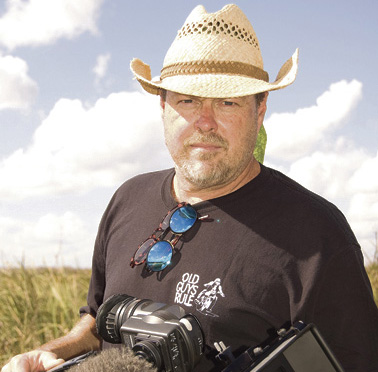
Wes Skiles is remembered by many for his pioneering work in underwater photography and filmmaking as well as environmenetal concerns.

HIGH SPRINGS – Underwater caves and passages were his second home.

Born in 1958, Florida native Wesley C. Skiles, better known as Wes, would be described by his friends and family as an explorer, an educator and a skilled storyteller whose passion was cave diving and learning about Florida's waterways. Sunday marks the third anniversary of his death while cave diving, but the legacy of the former High Springs resident is maintained by the people who knew him.

Wes was well known for his cave diving adventures and exploring Florida’s springs.

“It was like his church," said his wife, Terri Skiles.

Terri met Wes around 1980, when she was working a part-time job at a store and sold him a camera. They were married in 1981, and had two children, Nathan, 26, and Tessa, 20.

Wes was a pioneer in his photography techniques, said friend and water conservationist, Mark Long,

"He was the first photographer to get really good pictures in underwater caves," he said.

Wes' lighting techniques in particular brought vibrancy to his photographs of submerged caverns, Long said. "The cave pictures of old were kind of dull. He brought them to life."

He got into photography to show the world the size and clarity of what he saw regularly, Terri said.

"People didn't believe them when he told them how big these underground cave systems were," she said. "He loved to show what he had learned by picture taking or filmmaking,"

Wes also used his photos as proof that there were issues with the water.

"He was one of the first people to recognize problems with the springs. To prove what he was talking about, he started taking pictures," Terri said. Wes started taking water samples and talking to state officials about pollution in the 1980s. He used his skills as a diver to advance aquatic research.

By the end of his life, Wes Skiles had received awards and accolades for his photography. National Geographic featured him several times, in addition to naming him "Explorer of the Year" in 2011, the year after his death. Wes participated in a National Geographic expedition to Antarctica, where he was the first human to set foot on Iceberg B-15, the largest recorded iceberg in the world.

In 2004, the National Academy of Television Arts and Sciences awarded him the Regional Emmy award for his work directing the documentary “Water's Journey,” which tracked the path of water through Florida's aquifer, rivers and springs.

By the age of 16, Wes had drawn maps of the Florida aquifer, the network of underground waterways running beneath the state.

"I have those maps to this day," said Terri Skiles.

With only a high school diploma, he taught himself everything he could about the watershed systems in North Florida.

"He was always learning," Terri said. “He loved to share what he knew from experience.”

Wes was passionate about the environment, but he wouldn't call himself an environmentalist, she said. "He would call himself a conservationist."

Ross Ambrose, from High Springs, worked with Wes on the "Water's Journey" documentary as a producer.

"I think he was one of Florida's most passionate advocates for protecting and understanding our springs," he said. "Wes' education efforts were very encompassing."

Wes' friend, Mark Long, was involved with the documentary as well, acting as a model in front of the camera.  

"It was a way to make people care about their water, how valuable it is, and how to protect it," Long said. "He had incredible knowledge on what's going underground with our water. By the end of his life, he was lecturing people with Ph.D.s on this stuff."

Wes recognized how everyone contributes to a problem without making them feel guilty, Ambrose said. "Very few people aren't part of the problem, you can't look at things in black and white and good and bad," he said. Ambrose remembered several people talking to Wes about concrete plants polluting the Suwannee River.

"He looked back at the people and said 'didn't you just build a house?'"

Wes encouraged people to find solutions, rather than to focus on the blame, he said.

Through his cave diving experience, Wes noticed pollution, algae blooms and problems with water levels. He started giving presentations at schools in the late 1980s, and by the accounts of people who knew him, he could talk to children, professors and government officials alike.

"He was a great communicator; he could talk to anybody," said Long.  

"He was a crusader," said friend Jim Woods, owner of the Santa Fe Canoe Outpost in High Springs. "Early on, he saw the problems that we are now experiencing."

Although he had an impact in raising awareness for aquatic issues, his friends and family also remember him for his personality.

"He always wanted to be a kid," Terri said.

"He could have a business meeting planned, but if the surfing conditions were good in Jacksonville, he would go surfing," Ambrose said. "He very much believed in taking advantage of opportunities. You could have a business meeting anytime. You couldn't always go surfing."

"I've never once seen the guy in a bad mood," Woods said. "He always had a smile on his face."

Wes Skiles died June 21, 2010, while diving off the coast of Boynton Beach. His friends found his body at the bottom of a reef.

Despite being a scientist, adventurer, photographer and environmental advocate, his wife considers his family to be his biggest achievement. The couple went diving together many times over the course of their marriage that lasted nearly 30 years.

"He just gave me the best life I could have," she said. 

"He made it an adventure for me."

#     #     #

Email cmckinney@

Alachuatoday.com

Add a comment

Easton edging closer to Olympic training status

Details
CHELSEA GRINSTEAD
Local
31 July 2013
  •  Print 
  • Email

NEWBERRY – The Easton Foundations Archery Center’s local youth archery program is drawer closer to earning its designation as a Community Olympic Development Program (CODP) from the United States Olympic Committee (USOC).

Five department officials from the committee have already signed off. Just one more signature is needed, and Easton Newberry Sport Complex’s archery program will be part of a direct route for athletes to the archery Olympic training center just outside San Diego, said Doug Engh, national outreach director for Easton Foundations.

There are only about 10 archery CODP sites nationally, and to become one, the complex has undergone years of preparation and staff training following USOC guidelines and even earned an endorsement from archery’s national governing body, USA Archery.

The program’s preparation has been focused around becoming a funnel for the junior Olympics. Lesson plans are being worked under USA Archery standards, and there have been discussions regarding athletes’ transportation and understanding the USOC high performance system.

“We are ready to unveil the banners,” Engh said, who works with head coach Robert Turner to make the Olympian concept a reality at the complex.

The staff is currently looking at whether the certification will change the archery program’s class structure and curriculum, Turner said.

The weekly classes scale five skill levels from beginner to advanced.

“There has been a lot of success coming from our structure,” Turner said.

Just last Friday at the National Target Championships in Ohio, one of the program’s students came away with a gold medal.

The CODP certification may mean that the complex’s program could be changed to more resemble USA Archery’s national elite program, Junior Dream Team. Two local graduate archers are already in this traveling program.

The idea behind streamlining the archery program is not to weed out players who won’t reach Olympic caliber, but to have the option available for the community’s youth.

“That’s why the designation has come our way,” Turner said            

“We have already shown that we have a great series of classes and have produced champions.

This year, about 60 state champions came from the local archery program, and last year there were about 45.

“We are so proud of what our archers have done, and we look forward to being more formalized under the CODP,” Turner said.

There will be an unveiling and rebranding ceremony for the complex in August if all goes well, and invites will include committee members, national coaches and some gold medalists, Engh said.

“And the logo does include the Olympic rings,” Engh said.

#     #     #

Email cgrinstead@

alachuatoday.com

Add a comment

Waldo makes wastewater connection with GRU

Details
ALEX HART
Local
24 July 2013
  •  Print 
  • Email

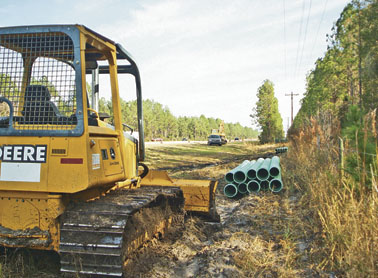
W - Waldo pipes DSCF7523The Waldo to GRU wastewater pipeline is under construction along Waldo Road.

WALDO – For 25 years Waldo has depended on the same municipal wastewater treatment plant for waste collection and treatment. However to avoid fines upwards of $10,000 per day, the city will now go through Gainesville Regional Utilities (GRU) for wastewater treatment and disposal.

The city’s wastewater treatment plant was unable to meet updated standards that were set by the Florida Department of Environmental Protection, FDEP, and has since received several violation notices.

“Waldo City Council held public meetings seeking a way to correct this problem in the most cost effective, environmentally sound and long-term manner,” said Kim Worley, Waldo’s city manager.

The final solution was to connect Waldo’s wastewater collection system to the GRU system for treatment using an 11-mile force main pipeline and to decommission the old wastewater plant. The project is being funded using a combination of a grant and to the City of Waldo from USDA Rural Development, totaling $5,364,300.

The city will have 40 years to pay off the loan portion. Since it is mandated by law that the loan must be repaid using revenues obtained through utility charges, residents will see an increase in monthly utility bills.

“For basic water services, the increase will be approximately $19,” said Worley. “The city has not had a rate increase since 2008, but it can’t be avoided for the new system.”

Residents attending last week’s city council meeting were not the only ones opposed to an increase in the utility rates.

“Listen, I know no one wanted to see an increase, but at the end of the day we had to raise rates for the future,” said Vice Chair Irvin Jackson.

When the new system is up and running, the city will not only be able to provide wastewater services at the current usage levels, but will have the capacity to double usage levels, which will accommodate population growth, before having to make any required additional expansion of the system with GRU.

“At the end of the day we had no choice but to make a change,” said Rick Pisano, city councilman. “A $10,000 a day fine? We’d have been broke in a week.”

#   #   #

Email ahart@

alachuatoday.com

Add a comment

More Articles ...

  1. Biodiesel pumping again
  2. Rain doesn't dampen holiday plans
  3. High Springs ‘Tweeners’ connecting to sewer system
  4. From the fryer to fuel
Page 199 of 307
  • Start
  • Prev
  • 194
  • 195
  • 196
  • 197
  • 198
  • 199
  • 200
  • 201
  • 202
  • 203
  • Next
  • End
Alachua County Today Alachua County Today

Explore

  • About Alachua County Today
  • Advertise
  • News
  • Community Calendar
  • Public Notices