
• About Alachua County Today
  • Advertise
  • News
  • Community Calendar
  • Public Notices
Alachua County Today Alachua County Today

Boukari Law, P.A.

 PLACE YOUR LEGAL NOTICES HERE

02
Mon, Feb
642 New Articles
  • Home
  • Advertise-Subscribe-About Us
    • About ACT News
    • Advertise
    • Subscribe
  • Calendar
    • Calendar
    • Gov't Meetings
  • News
    • Local
    • Obits
    • Sports
  • Public Notices

From tires to turf

Details
ALEX HART
Local
02 February 2014
  •  Print 
  • Email

W - ntireform


Photo special to Alachua County Today

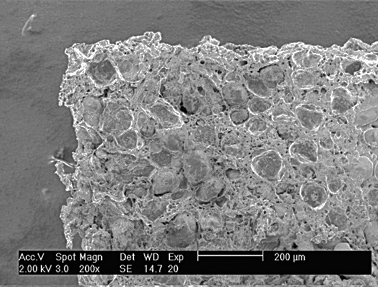
This microscope image shows the structure of the fertilizer made from recycled rubber.
ALACHUA – Dan just spent the entire day working on his lawn, laying fertilizer throughout his yard. Then just 15 minutes after he heads inside, the clouds open up and rain begins to pour down. Any chance of that fertilizer being effective would have been washed away, but a new product could change that.

The company is called Eigenchem, and they are working on a new recycled waste product that acts as an efficient fertilizer, as well as an asset to the ground, even after the nutrients are released.

Alexander Oliferenko is the president and chief science officer or EigenChem Technologies Inc., and he and the company have been working in the Sid Martin Biotechnology Incubator in Alachua for the past three years.

The idea was to set out and conduct research with recycling waste and find a way to reduce the harmful impacts it can have on the environment, Oliferenko said.

“The plan was to liquefy rubber, and we actually discovered, quite accidentally, a very good nitrogen fertilizer,” Oliferenko said. “Our product is approximately 60 percent fertilizer and 40 percent rubber, after the reaction.”

It looks similar to rubber, but has a very different composition to it. It appears to have little holes or pores, and is much softer as well.

The patented product is called NTireForm, which, when broken down stands for nitrogen, tire and formula. It also can be read like entire-form, for a complete formula, Oliferenko said.

It works just like any other fertilizer, until it reacts with water. Standard fertilizers are almost completely washed away when it rains, but NTireForm absorbs the water, swells up and releases the fertilizer over time. It takes roughly two to three months for the process to completely release all the nutrients, Oliferenko said.

“After the nutrients have been dispersed into the ground, the left-over agent is incredibly absorbent,” Oliferenko said. “It is very sponge-like, and can hold almost eight times its own volume in water.”

The company began working on the product several years ago. Six months ago, it received a $150,000 grant from the National Science Foundation to test their idea and work on a proof-of-concept. Oliferenko turned in his last report for the grant two weeks ago.

“We had a good proof-of-concept and produced eight batches of material,” Oliferenko said. “We also managed to add potassium to our product, making it an even greater fertilizer than before.”

Now, the project is set to enter phase two. They have applied for another grant, this one for $750,000. For the next two years, EigenChem is going to be working alongside Jason Kruse in the Environment and Horticulture Department at the University of Florida to conduct field trials.

The main facet of phase two is going to be in commercialization and customer identification, Oliferenko said.

“I think the best application for our product in the field trials will be in turf-grass management,” Oliferenko said. “It could be golf courses or sports fields. But, it will also be an excellent product for landscaping and other lawn maintenance.”

EigenChem is a notably successful business out of the Sid Martin Biotech Incubator, said Patti Breedlove, the director of the incubator. The average stay for a company in the program is five years, but it can be more or less.

“A company must apply for admission, and not all are accepted,” Breedlove said. “Each year, they are reviewed to see if they will be renewed for another year, and graduation is customized for each company.”

The incubator provides business guidance, introduces companies to investors and helps with networking the young companies as well, Breedlove said.

The program lowers barriers to entering the market by giving access to affordable lab space and offering leadership throughout, said Nathalie McCrate, a public relations intern for the incubator.

“Any early-stage bioscience company has to overcome daunting challenges, and Sid Martin helps the likes of EigenChem translate scientific discoveries from the lab bench to the marketplace,” McCrate said.

“It truly is a great facility,”Oliferenko said. “We started with just two of us and an idea, and now we have two full-time and two part-time workers on the project.”

Oliferenko started three years ago with a problem he hoped to solve.

“It is always tempting to work on turning waste into a valued product,” he said. “We took that desire and turned it into a great opportunity.”

#     #     #

Email ahart@

alachuatoday.com

Add a comment

MLK: Over 50 years of the dream

Details
CARL MCKINNEY
Local
02 February 2014
  •  Print 
  • Email

W - MLK Alachua DSC 3493

CARL MCKINNEY/ Alachua County Today

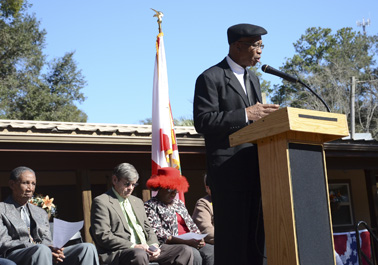
 The Rev. George Trotman begins his speech at the MLK celebration. He read the famous "I Have a Dream" speech in its entirety.

 ALACHUA – A city gathered to celebrate one of the 20th Century’s most famous civil rights activists.

The City of Alachua held its celebration of Martin Luther King Jr. for the ninth year in a row on Monday, Jan. 20 at the Hathcock Community Center.

The ceremony started around 11 a.m., with Wilma Rogers, who helps run the Alachua Music and Arts Program, giving a speech on the changes King brought about.

“That change lives on inside each of you,” she said. Positive change is rewarded by God, she added.

After Mayor Gib Coerper acknowledged the veterans in the audience for their service, City Manager Traci Cain gave her interpretation of the celebration.

“What a beautiful day it is to come together as neighbors, friends and family,” she said.

Cain talked about the sacrifices King made for civil rights.

“He put his life on the line for what he believed,” she said. She spoke of the hope he had.

“Let’s continue to have hope.”

Rogers then brought the children of the Music and Arts Program on to the stage to sing “We Can Change the World,” composed by Wilma Rogers’ husband, Bill Rogers. Samantha Flores, one of the young singers, led the performance.

The group recently had a chance to visit Martin Luther King Jr.’s home in Alabama. They have also been invited to attend the Trumpet Awards in Atlanta, Ga. at the end of the month to represent Alachua. The show will be televised in 185 countries.

Joni Perkins, from the Music and Arts Program, recited the Maya Angelou poem “Still I Rise,” which challenges everyone to hold their head high and empower themselves and others.

Wilma Rogers took the stage again, this time to thank the parents for their support of the Music and Arts Program.

“We cannot do this without you,” she said.

The Rev. George Trotman then took the stage as the main speaker, talking about the lasting impact of Martin Luther King Jr.

“Truly, this is a good day,” he said. “We are blessed to be in a land where we can assemble together.”

If Martin Luther King Jr. was still alive, Trotman said, he would say all honor and praise should go to God, not himself.

“We thank God for Martin,” he said. “The one prevailing thought was his love for humanity.”

Trotman recited the entirety of King’s famous “I Have a Dream” speech.

As Rogers closed the ceremony, she invited the audience to remember, celebrate and act. She challenged everyone to follow through on their dreams. She also asked people to share an appreciation for history with the youth, something she said many young people lack.

For the rest of the afternoon, residents ate barbecued meat, listened to musicians strum guitars and conversed with one another.

#     #     #

Email cmckinney@

alachuatoday.com

Add a comment

Country’s first 3D fluorescent art museum

Details
BRIANA ERICKSON
Local
02 February 2014
  •  Print 
  • Email

W - 3D 3dart

Artwork special to Alachua County Today

This piece demonstrates how artists can use the 3D effect to give depth to their work.

 NEWBERRY – In what some people might have seen as a place for rent in Newberry, a local Gainesville man saw his vision in action.

“I got a really good feeling about the place,” said Robert Roberg, who teaches foreign students English at the University of Florida.

This little place for rent on 25310 W. Newberry Road is now America’s First 3D Fluorescent Art Museum. The museum will have its grand opening on Feb. 21. Open on Friday nights from 7 p.m. to 9:30 p.m. and Saturday from 2 p.m. to 8 p.m. with special events on Sundays, the museum will also be offering both children and adult classes.

He came across the place for rent when he went out to visit the Firehouse Gallery. Newberry has always been a place that appealed to him ever since he and his wife started frequenting the local Backyard BBQ for their anniversary, he said.

Now, Newberry is becoming the place for one of his favorite things.

“I was always painting my whole life,” he said. “One of those things you love to do, so you just keep doing it.”

He has been serious about painting since 1985. Roberg has two paintings on display in the Smithsonian Museum of Art.

Entry to the 3D art museum is free and the 3D glasses will be $3. Since Roberg first laid eyes on it in the middle of December, he hoped it will bring a unique, family friendly experience to the area.

“It’s a chance to let people see another level of art,” Roberg said. Different from any other museum in the world, those observing the painting can feel like they are a part of the scenery because of the 3D effect.

He also hopes to offer 3D black-light films and puppet shows. His wife will be teaching the classes for children, and he will be teaching the adults.

“She’s excited,” he said. “She’s very creative, and loves working with little kids.” Any artwork produced at these classes will have an opportunity to be displayed in the museum for free.

Roberg first came across the 3D idea several years ago when he found a website on the internet that was selling 3D glasses, featuring a tutorial that explained how one could combine a certain technique of painting and glasses that could result in a 3D image. “It’s not perfect yet,” he said. “But, it’s a lot of fun trying to sketch it.”

“The goal is to make the image come out of the canvas as far as you can, or recede into the canvas as deep as you want,” Roberg said.

He hopes that a lot of people in Alachua County will become inspired to become black-light painters, and that the museum will become a place where they can send their art.

His goal is for the museum to have about 100 paintings by the time the grand opening comes along. Right now, there are about 50. An artist from Tallahassee, Perdita Ross, came down this weekend and brought 30 fluorescent black-light paintings.

“The ultra violet light makes the paint glow, and the 3D glasses make it look like its floating in the room, and you can reach out and touch it with your hand,” Roberg said.

The only other museum like this in the world is a fluorescent museum located in Amsterdam. Two years ago, when Roberg was in the country, he tried to visit three times, but to no avail.

“I was never able to go inside. But, once I saw it in Amsterdam, I knew that I had enough material to open my own museum,” he said.

He said he wants the museum to be a new, interesting experience that will attract tourists to Newberry. The museum will also provide educational skills and give artists from Alachua, High Springs, Newberry, Archer and other small towns a new inspiration for people who want to become black-light artists.

“I know I have something unique,” Roberg said. “I just want people to see it.”

#     #     #

Email berickson@

alachuatoday.com

Add a comment

Fierce guards, loyal companions

Details
BRIANA ERICKSON
Local
02 February 2014
  •  Print 
  • Email

W - dog - DSC 3548

CARL MCKINNEY/ Alachua County Today

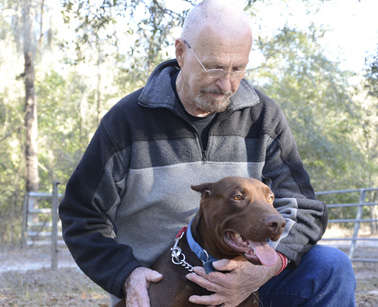
Mulvey show off his dog, Rudy. Mulvey will use Rudy as a demonstration of the kind of guard dogs he is training.

NEWBERRY – A 3-year-old Doberman has captivated Neil Mulvey’s life for the past four weeks.

A new year means a new addition to his business, the Personal Security Institute, located near Newberry.

Mulvey has spent over two decades in law enforcement and security defense instructing.

After spending time working for the North Miami Police Department and as a defense tactics and hand-to-hand instructor in South Florida, he decided to move the franchise to Alachua in 1988.

Established in Newberry, beginning as the Alachua Karate Center, Mulvey’s Personal Security Institute has resided there ever since.

Since then, he has expanded this business into firearms and concealed weapons training.

Now, an idea for a new service has been incorporated into Mulvey’s business.

The expansion starts with Rudy, the 3-year-old Doberman at his feet.

“People are in a period of feeling insecurity, and home invasions are on the rise,” he said.

Because of this insecurity, Mulvey decided to train dogs in his business, a skill he learned in his career in law enforcement.

In the training of what he calls a “dual personality home protection dog,” Rudy is the first dog to test the waters of the market, who he thinks should be ready and prepared to face home intruders.

“An immediate psychological and physical deterrence from strangers is a biting dog in the house,” Mulvey said.

Rudy will be taught to protect the house from strangers and bite on command.

Mulvey talked about the work he has done on Rudy so far.

“Well, actually, he is working on me,” he said, laughing.

The selection for a dual personality home protection dog is not simple, Mulvey said.

“Some will wash out, and some will make it,” he said. The dogs must have the correct disposition for them to socialize properly, and need a certain degree of intelligence.

“They can’t be a terror,” he said. These dogs, like Rudy, must have an aggressive nature that can be controllable in the home.

“Dogs that aren’t a ninja 100 percent of the time,” Mulvey said.

The hounds will be selected from the breed of shepherds, Dobermans, and Rottweiler’s. The training will take about four to six months.

Rudy’s training started with basic obedience, and then advanced obedience. He will move on to protecting enclosed spaces, protecting the house and then learn attacks.

“You tell him to sick the intruder and he’ll do it,” he said.

Before a dog goes with the owner, there is a transitional period in which the owner and the new, already-trained companion must get accustomed to each other.

“The dogs must be taught how to channel their aggression to certain parameters,” Mulvey said. By getting to know each other, the owner of the dog will be able to call him off a bite.

“Rudy will be my dog,” Mulvey said. He will use him as a demonstration.

Mulvey’s goal is to create interest in an added level of security, as well as a companion.

“That’s Rudy’s job,” he said.

#     #     #

Email berickson@

alachuatoday.com

Add a comment

Lawmakers talk county's boundary act

Details
CARL MCKINNEY
Local
20 January 2014
  •  Print 
  • Email

A legislative delegation in Gainesville decided to move forward with a bill that would change the ways each of the nine cities in the county can annex territory.

State Sen. Rob Bradley, R-Fleming Island, and state Reps. Keith Perry, R-Gainesville, Elizabeth Porter, R-Lake City, and Clovis Watson Jr., D-Alachua met Friday, Jan. 10 to discuss repealing the Boundary Adjustment Act.

They voted 4-0 in favor of moving forward with the bill that would repeal the old law.

Passed in 1990 by the state legislature, the act only applies to Alachua County and was meant to control growth in urbanized areas outside of city limits.

The four legislators met at the Santa Fe Center for Innovation and Economic Development in front of citizens and officials from various cities.

Eight out of the nine municipalities in the county were in favor of repealing the law, with Gainesville being the only city in opposition.

The act sets aside urban reserve areas, zones that are urbanized or expected to be urbanized that a city can annex. It also establishes a process cities have to go through before annexation.

Gainesville is open to revising the act, but not eliminating it, said City Manager Russ Blackburn.

Thomas Hawkins, Gainesville city commissioner, worried that repealing the Boundary Adjustment Act could lead to conflict between cities over territory.

Former mayor of Alachua, Jean Calderwood, said the act is burdensome to private property owners who want to be annexed into a city.

“My position is that it should be repealed, period,” she said.

Under the Boundary Adjustment Act, a property owner has to prepare an urban services report that shows the city can properly provide utilities and services to the property.

The report then has to be adopted, meaning it must go through a public hearing process. The property owner must also pay to advertise for the public hearings.

“It can become costly to do that,” Calderwood said.

Under the general state law that applies to the rest of the counties in Florida, the property owner only has to prepare the report, she said. When the Boundary Adjustment Act was passed, the general statute governing the rest of the state was less developed.

The county is waiting to discuss the issue before adopting a stance, said county spokesman Mark Sexton.

There is a public workshop on Feb. 4 where the county commission can learn the details and historical information regarding the law, and debate the pros and cons, he said. On Feb. 18, there will be a joint meeting between the county and the Florida League of Cities.  

“We’re going to kind of hash it out at that point,” he said.

Current mayor of Alachua, Gib Coerper, said the current rules add a layer of bureaucracy that isn’t needed to the city planning process.

“It makes planning more expensive and time consuming,” he said.

Frank Ogborn, mayor of Archer, agreed.

“It’s an onerous level of government,” he said.

The City of Gainesville wants to keep the urban reserve areas established by the act, said Russ Blackburn, city manager.

Though the delegation voted to move forward with the bill repealing the Boundary Adjustment Act, it is still in an early process. The cities, county and state legislators will still engage in a dialogue to debate the issue. The bill would have to pass through the state legislature.

#     #     #

Email cmckinney@

alachuatoday.com

Add a comment

More Articles ...

  1. Newberry city manager to retire
  2. Alachua eyes development block grant
  3. High Springs women vying for artistic recognition
  4. History wizard watches over county’s past
Page 183 of 305
  • Start
  • Prev
  • 178
  • 179
  • 180
  • 181
  • 182
  • 183
  • 184
  • 185
  • 186
  • 187
  • Next
  • End
Alachua County Today Alachua County Today

Explore

  • About Alachua County Today
  • Advertise
  • News
  • Community Calendar
  • Public Notices