

• About Alachua County Today
  • Advertise
  • News
  • Community Calendar
  • Public Notices
Alachua County Today Alachua County Today

Boukari Law, P.A.

 PLACE YOUR LEGAL NOTICES HERE

31
Sat, Jan
642 New Articles
  • Home
  • Advertise-Subscribe-About Us
    • About ACT News
    • Advertise
    • Subscribe
  • Calendar
    • Calendar
    • Gov't Meetings
  • News
    • Local
    • Obits
    • Sports
  • Public Notices

School Board Adds Career and Technical Education Focus at A. Quinn Jones to Address Discipline Issues
Details
Administrator
Local
17 May 2023
  •  Print 
  • Email

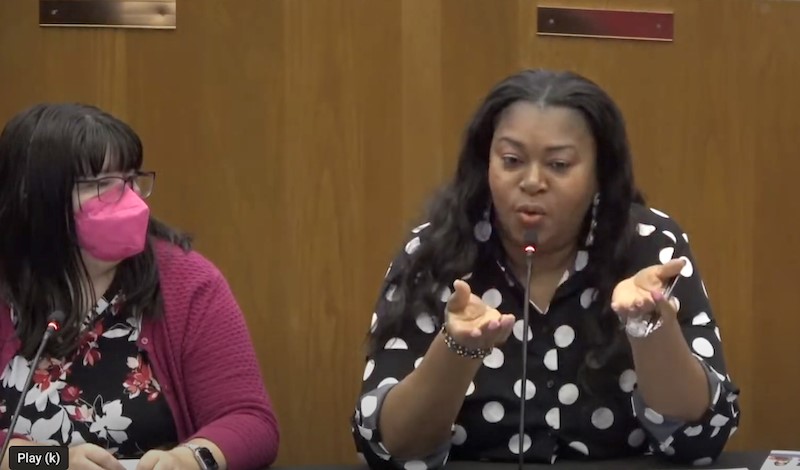
School Board Member Diyonne McGraw weighs in on alternative school models at the May 3 workshop | From Alachua County Public Schools broadcast video

BY AMBER THIBODAUX/Alachua Chronicle

GAINESVILLE, Fla. – The Alachua County School Board held a workshop on May 3 where they discussed the ongoing behavioral issues and discipline problems facing the district and how best to deal with them. Chief of Equity, Inclusion, and Community Engagement Anntwanique Edwards gave a presentation that outlined six different models (shown below) that the school board could implement to provide further assistance to teachers and students. All six models focused on removing or relocating students with behavioral issues and giving them extra support in more structured settings. Edwards told the board that the referral rate has “skyrocketed,” not just in secondary schools but also in elementary schools, and that the types of behaviors leading to the referrals are of major concern.
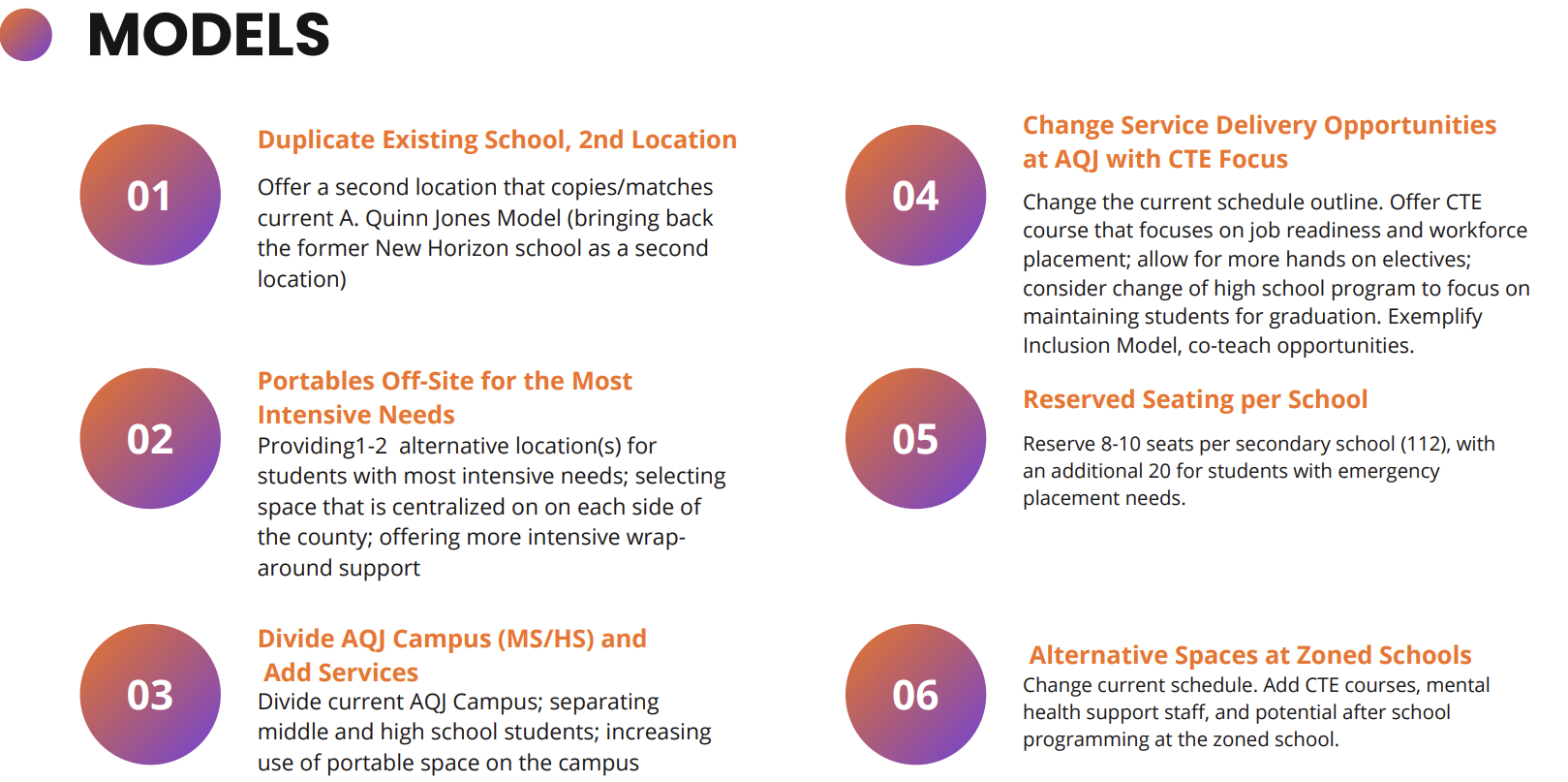
SBAC workshop Models

Slide from Dr. Edwards’ presentation at May 3 workshop


“We know that increased trauma has occurred with many of our students, especially since COVID, and we would like to minimize the number of various behavioral types that are sitting on one campus,” Edwards said. She noted the various “neighborhood associated issues” (i.e., rival gangs) that carry over to school campuses but said she couldn’t say with certainty that those conflicts would be resolved by creating a second alternative school. She also mentioned the increase in student weapons charges and gang affiliations and worried about separating those students out while at the same time serving their individual needs off-site.

Career and Technical Education focus

After listening to the pros and cons of each model and associated costs, the board unanimously agreed to proceed with Model 4, which would change the service delivery at A. Quinn Jones (currently the only alternative placement school in the district) to a Career and Technical Education (CTE) focus. Edwards told the board that she had spent extensive time looking at alternative schools across the nation to see which models work best.

“What appears to be most consistent with alternative school placements is really about how we’re delivering services to students – being able to provide those wrap-around services, helping kids to be able to make connections between where they are now and their future, how they’re going to be prepared for it, the employability skills,” Edwards said.

She explained that those students who were most successful were graduating from their alternative school placements instead of going back to their zoned schools, then asked the board to consider investing more money into a setting where a CTE program and mental health services are offered all in one place. 

“There are kids who typically do well in smaller settings, and I think it is probably the fallacy a lot of times in education and other support areas where we take students and we put them into settings, and they do well, and they’re successful, and then we put them back into places where they were unsuccessful – when in reality, the culture and the environment of the small setting was what allowed them to have that success.”

Currently the student-teacher ratio at A. Quinn Jones is very low, with some classes having between 0-3 students per teacher (zero in cases where no students show up to class). The school has 181 spots available but only 107 students are enrolled; 21 of those students have committed felony offenses, and 31 are transfers from other alternative programs or school districts. The school is designed with an exit plan for students to return back to their zoned schools if possible. However, under the proposed Model 4, students at A. Quinn Jones would be provided with alternate education opportunities that are predicted to be of high interest, would receive instruction based on their individual learning styles and needs, and would be given help in behavior support and career readiness preparation. These students would ultimately graduate from A. Quinn Jones.

Edwards also suggested partnering with UF to deploy Board Certified Behavior Analyst (BCBA) interns at various schools, since the county only has one BCBA currently employed to serve the entire district.

Edwards said she had spoken with some people at UF and found that they provide other districts with BCBA interns, but not Alachua County. She concluded, “I think they are definitely amenable and open and so we have some upcoming conversations about how can we partner with [UF] in order to be able to get some of that insight from the people who specialize in working with behavior.”

Several factors have delayed staff’s response to board requests for better discipline

Edwards completed her presentation by acknowledging the “delayed responses” in addressing the behavior issues and said the delay had been caused by a lack of existing systems, the difficulty of creating a new system while dealing with day-to-day responsibilities, labor shortages, a lack of written documentation, and an increased number of crisis situations that require an immediate response.
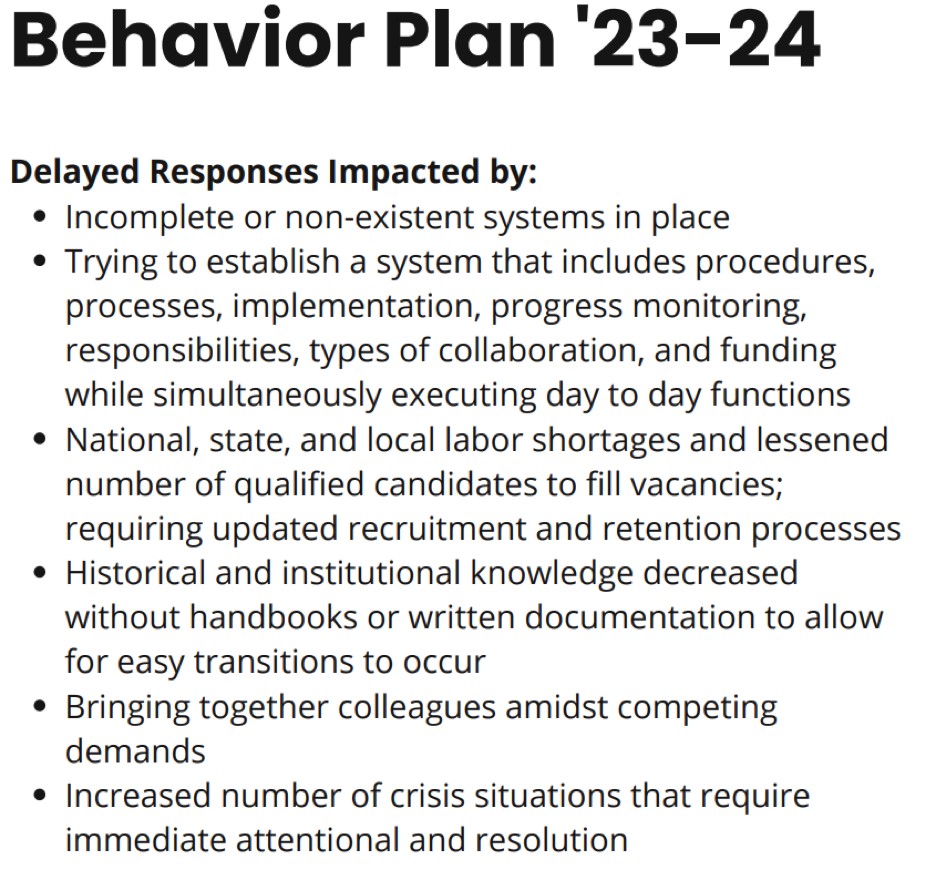
Behavior Plan

Slide from Dr. Edwards’ presentation at the May 3 workshop


McGraw and Abbitt emphasize the need for communication and consistency

Board Member Diyonne McGraw said that she continues to be in favor of an additional alternative school because most of the staff members she’s spoken with say that the Positive Behavioral Interventions and Supports (PBIS) model that the district currently follows is not working. “When a kid brings a gun to school and when someone is continuing to attack, they need to be pulled out, they need to be worked with,” McGraw said.

McGraw also addressed the importance of parental involvement and a Parent Academy, saying that she continuously receives phone calls from parents who need help: “Once we build relationships and you’re talking to parents, that’s extremely important.” 

“It’s not about snatching a kid out and separating them, but sometimes, given where we are past COVID, because there’s a lack of discipline – consistent discipline – in the homes, it is affecting us here at the school system. So when you talk about this, this is a lot of work. That’s why you need all the players,” McGraw said.

Member Kay Abbitt stressed the importance of having equal and consistent consequences for negative behaviors so parents and teachers understand what the consequences are for specific infractions. “If I vape in a bathroom, this is my consequence. It doesn’t matter if you’re an A student in school, or an F student in school, or purple or pink – this is what’s going to happen.”

“If you don’t know what the consequence is and if it’s not enforced consistently at schools – and I know for a fact that it’s not because I’ve spoken to teachers and deans and it’s not enforced… to me these things are very simple. You have a rule that someone has to follow, and you have a consequence, and you enforce it,” Abbitt said.

She also emphasized that the district needs to have a behavioral plan in place and “market it like crazy” with a no-nonsense approach, as well as a “Professional Development” plan that goes out to parents who may need help with learning coping skills or parenting techniques.

Chair Tina Certain wrapped up the discussion by taking an informal vote to proceed with Model 4 at an estimated cost of $64,000+, the least expensive of all the models proposed. She reminded the board that “something is going to have to be cut” to secure the funding. 

The workshop can be watched in its entirety here.

#     #     #

Email editor@

alachuatoday.com

Add a comment


Bureau Of Alcohol, Tobacco, Firearms and Explosives (ATF) Joins Investigation into Chemical Explosion

Details
C.M. WALKER
Local
16 May 2023
  •  Print 
  • Email

HIGH SPRINGS ‒ The Bureau of Alcohol, Tobacco, Firearms and Explosives (ATF) sent its National Response Team and joined the investigation into the May 4 explosion that injured at least four people at Air Liquide Advanced Materials in High Springs. At 4:01 a.m. on Thursday, May 4, the High Springs Fire Department was dispatched to Air Liquide, 17526 High Springs Main Street, for a reported explosion. Within minutes, firefighters arrived at the site of an active fire with multiple people injured.

Four Air Liquide employees were injured as a result of the explosion, one of whom was air-lifted by ShandsCair medical helicopter. The other three were transported by ground to area hospitals for evaluation and treatment and have been released. “The employee air-lifted by ShandsCair remains in the hospital as far as we know,” said City of High Springs Public Information Officer Kevin Mangan on Monday, May 8.

Gainesville Fire Rescue’s Regional Hazardous Materials (HazMat) team responded to the scene to evaluate the area of the explosion. After a thorough inspection by the HazMat team, it was determined the incident was contained and infrastructure in the affected building was secured. Alachua County Fire Rescue’s drone team was also requested to aid in the mitigation and investigation efforts.

No injuries to first responders were reported. High Springs Main Street was closed between Northwest 182nd Avenue and Northwest 174th Avenue for approximately nine hours. The cause of the explosion remains under investigation by the Florida State Fire Marshal’s Office and The Bureau of Alcohol, Tobacco, Firearms and Explosives (ATF), said Mangan.

Air Liquide supplies industrial gases and services to various industries including medical, chemical and electronic manufacturers.

NRT members arrived in Florida on May 6 to assist the Florida Bureau of Fire, Arson, and Explosives Investigations and other local and state partners in this ongoing investigation. The NRT consists of Special Agents, Certified Explosives Specialists, Explosive Enforcement Officers, Certified Fire Investigators, Fire Protection Engineers, Electrical Engineers, Forensic Chemists, an Intelligence Research Specialist, a Medic, and an Accelerant Detection Canine with handler.

“ATF is going to help examine the scene, investigate the leads and follow the facts to how this tragedy may have occurred,” said Special Agent in Charge Kirk Howard. “Extending our unique expertise and capabilities demonstrates the division’s respect for our Central Florida partners and underscores ATF’s commitment to public safety.”

#     #     #

Email cwalker@

alachuatoday.com

Cont.:     Explosion still under investigation

Add a comment

Mama Mia! Prohibition Pizza Opens in High Springs

Details
RAY CARSON
Local
12 May 2023
  •  Print 
  • Email

HIGH SPRINGS ‒ There’s a new restaurant in town as High Springs welcomes Prohibition Pizza. New to the restaurant business, owners Kelly and David Potter both had successful careers, Kelly in real estate and David as a contractor. Yet they had other career dreams they wanted to pursue.

Fueled by a love of cooking, after moving to High Springs the couple began a plan to open a restaurant. Kelly originally wanted to open a Mexican restaurant, but El Patio opened earlier and they saw no need for two Mexican restaurants in a small town. David’s love for Italian food, especially pizza, pushed them to a pizza culinary school in New York to become specialized chefs known as Pizzaiolos.

“We picked the New York school because we wanted to make traditional New York style, with handmade dough and all natural ingredients,” Kelly said. “But at the same time, while keeping the style authentic, we wanted to create original recipes as far as the toppings and decided to concentrate solely on specialized pizzas.”

After two years of planning and work, Prohibition Pizza held its grand opening on April 20. They restaurant celebration with an official ribbon cutting ceremony with the Potter family accompanied by High Springs Mayor Gloria James, Vice Mayor Ross Ambrose, Commissioners Tristan Grunder and Katherine Weitz and Chamber of Commerce President Sharon Decker. After the ribbon was cut, the large audience of residents and business owners were treated to cake. For people who had brought their dogs to the outdoor ceremony, Kelly had a special treat. Each dog got a large frisbee resembling a pepperoni pizza.

Kelly said they had been planning for over a year. Once they found a location and purchased the building, there was a lot of work to do in addition to building a kitchen from the ground up.

“With David's background in construction, we did much of the work ourselves with help from the family,” said Kelly. Although the building needed a lot of work, the couple liked the location, a block off Main Street and across from the High Springs Brewing Company. “Pizza and beer are a well-known combination, and we are happy to have a working relationship with the Brewery,” said Kelly. “We have applied for a beer and wine license, but we would prefer to keep the relationship as is for the benefit of both businesses.”

“We were amazed by the turnout and warm support of the community for our opening. We were even more amazed by the amount of business we got the first two days,” said Kelly. “Both days we ran out of dough to make pizza because our dough is made fresh daily and takes three days to rise properly.”

They did not expect to have over 1,000 customers the first two days, but have since adjusted for it. “Currently we only offer walk in orders or in house dining but will later do phone orders and possibly delivery,” said Kelly. “While we specialize in pizza, we also offer oven baked wings, salads, appetizers and desserts.”

Prohibition Pizza is located at 18559 N.W. 237th Street in High Springs They are open six days a week with the exception of Tuesday. More information on hours and a full menu can be found on Facebook at https://www.facebook.com/prohibitionpizzaHS/

#     #    #

email rcarson@

alachuatoday.com

Add a comment

County Commission Approves Meeting Rule Changes, Asks Governor to Veto Fertilizer Research Allocation, Discusses Future Four-Laning of Archer Road

Details
Administrator
Local
12 May 2023
  •  Print 
  • Email

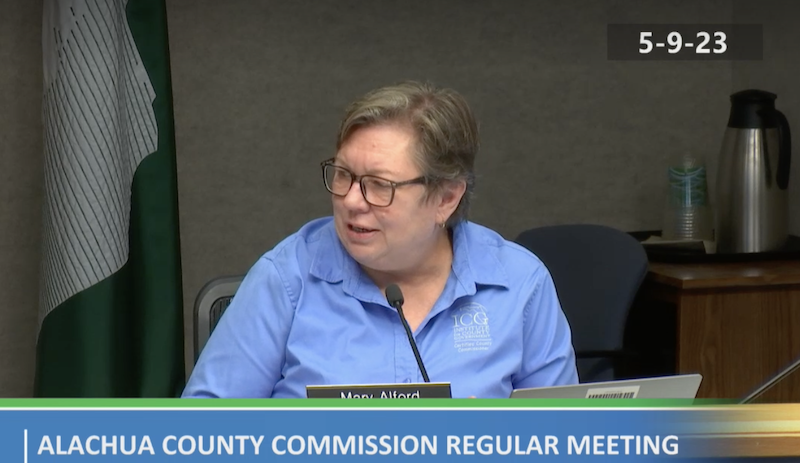
County Commissioner Mary Alford asks the board to begin discussing the four-laning of Archer Road going west

BY JENNIFER CABRERA/Alachua Chronicle

GAINESVILLE, Fla. – At the May 9 Alachua County Commission meeting, the board made some changes to their meeting rules, voted to ask the governor to veto an allocation for research into seasonal fertilizer restrictions, voted to send a Chair letter to the smaller municipalities asking for funding to develop a county-wide literacy plan, and voted to begin discussions that could lead to four-laning Archer Road going west in eight to ten years.

Thumb drives to be prohibited in County meetings

The changes to meeting rules were originally on the consent agenda, and during the adoption of the agenda, Commissioner Marihelen Wheeler said she’d had requests to pull the meeting rules from the consent agenda and put them on the regular agenda for discussion, but she thought it could be handled during “citizen comment.” 

During public comment on the adoption of the agenda, Jo Beaty asked that the item be moved to a different meeting, providing more time for citizens to review the changes, which were discussed at a lightly-attended Special Meeting on May 2. Beaty particularly objected to a prohibition on bringing in thumb drives with material to be displayed during public comment. 


Tamara Robbins said she believed that the prohibition on thumb drives arose because Commissioner Mary Alford didn’t want to see a video of a slaughterhouse. Robbins said she had asked County Communications Director Mark Sexton about the policy on bringing in videos that are loaded on portable devices, and she believed that request generated the rule change. Robbins said the County allows developers to bring in presentations on thumb drives and that she thought the rule discriminated against the public. 

Commissioner Ken Cornell said he thought there should be a way to allow the public to bring in material on thumb drives, “the same way we do it for developers,” perhaps by isolating the presentation computer from the network. 

Commissioner Mary Alford agreed that they should be able to come up with a way for members of the public to bring in material and that the reason she’d been concerned about the slaughterhouse video was a concern about “any video that might provide any sort of triggering type of presentation to anyone.” She said that might include “any type of violence or some aspect of racism or something that might be presented to the public at a meeting in a way that might not be appropriate.” She said free speech allows that sort of content, but she asked the public to be aware that whatever they show will be seen by a wide range of people, including children. 

Commissioner Chuck Chestnut thanked the citizens for bringing this to the attention of the board because he said citizens shouldn’t be excluded from bringing thumb drives if developers and other presenters can bring them. 

County Manager Michele Lieberman said that presentations that are part of the agenda come through County staff by email prior to the meeting and also that the computer used during citizen comment is “tied into all the equipment that you’re seeing, that operates your broadcast. So while this computer may be isolated from the network, it is tied into our entire broadcast system. So something introduced improperly into that system could bring down our system.” She said staff would make sure that anyone who is presenting to the board would not put a thumb drive into the system. 

County Attorney Sylvia Torres summarized the changes to the rules:

  • If a Board member or County Manager wants to cancel a Special Meeting within 24 hours of that meeting, the meeting they want to cancel will be held, public comment will be taken, then the vote on canceling the meeting will be taken. In emergency situations or if it is clear there will not be a quorum, the Commission Chair or County Manager may cancel a Special Meeting, even if it is scheduled to start within 24 hours.
  • Advisory boards and the County Commission may hold “remote workshops” (where no action will be taken) as long as a physical location is provided for the public to attend and the public has the option to attend remotely.
  • Some changes were made to the quasi-judicial statement that is read by the County Attorney at quasi-judicial public hearings “because it is cumbersome and legalese.”
  • Members of the public are explicitly permitted to use the microphone and overhead projector to present or support comments, but any time needed for setup will count toward that person’s time. 
  • Types of speech that are not protected by the First Amendment, such as fighting words, defamation, and obscenity, are prohibited. 

Cornell clarified that developers will not be able to bring a thumb drive, and Lieberman said she would make sure that staff and developers understand that would no longer be permitted and there would no longer be exceptions.

The vote to approve the agenda, including the rules, was unanimous. 

Request to the governor to veto a line item in the budget

During commission comment, Lieberman brought up a letter that Alachua County Water Resources Program Manager Stacie Greco had sent to commissioners the previous evening, asking that the board send a Chair letter to Governor Ron DeSantis, asking him to veto a line item in the budget that would prohibit local governments from adopting or amending urban fertilizer ordinances that include a blackout period and would allocate $250,000 to UF IFAS to study the effectiveness of seasonal fertilizer restrictions. Greco wrote that the Sierra Club is looking for local governments to add their names to a letter asking the governor to veto the prohibition and allocation. 

Greco’s letter to the commission states, “Alachua County has a strong fertilizer ordinance, and it is important for other local governments to be able to do the same and for us to be able to make changes as needed. While [the Environmental Protection Department] is typically supportive of scientific studies, the fate of fertilizer restrictions should not depend on a fast-track study by the very institution that actively spoke out against our fertilizer restrictions in 2019.”

Cornell made a motion to both sign the Sierra Club letter and send a separate letter from Alachua County. The vote to approve the motion was unanimous. 

County-wide literacy plan

Cornell, who is on the board of the Children’s Trust of Alachua County (CTAC), also made a motion to send a Chair letter to the small cities in the county, asking them to join a county-wide literacy program. He said the County will contribute $40,000 to the effort. 

During public comment on the motion, Tamara Robbins asked whether the request was for funding support and said the letter should suggest an amount for municipalities to contribute: “I’d like to see it have more teeth in it so they actually see the importance of it and the relevance of it and the opportunity that comes with it.”

Cornell said the letter could mention the County Commission’s joint meetings with the school board and with CTAC and could suggest a “nominal amount. You know, I think $40,000 from us, if we can get the City to put something in, and the school board to put something in, even $10,000 from the small ones, I think that would be enough to do this project.” He said if each smaller municipality puts in $5,000 or $10,000, they should be able to get to $100,000, and he thought that would cover it. 

Chair Anna Prizzia said they had asked the Library District for $40,000 and had asked the school board to match the County’s $40,000, “so that’s already at $120,000. I think it’s like a $200,000 project.” Cornell suggested that the letter should state a goal of $200,000.

Wheeler asked, “What is the program? What are we funding?” Cornell responded that at the first joint meeting with the school board, the County Commission Chair said we really need a county-wide literacy effort, and through CTAC’s “listening project, it became clear that the whole community is interested in moving literacy forward. I know it’s one of the major priorities of the school board, when they talk about rezoning, shrinking the achievement gap, and their strategic plan–literacy is a big component of that.” He added, “We need to fund some experts to help us put together a plan.”

Prizzia added that the funding is for “all the experts who’ve been at the table, kind of working on literacy programs… to get together and put together a plan to make a roadmap for literacy that would outline the steps we need to take across the board and be sort of a living document that pushes us all in the same direction.” She said they keep hearing “again and again from the experts… that we have a lot of good projects that are very piecemeal and aren’t being worked together in a unified way, and it’s resulting in poor outcomes for our children.”

Wheeler said she thought the problem could be solved by educators, “the people that are actually trying to solve the problem” and that they shouldn’t be “paying money out for experts on the outside to come in and tell them how to do what it is they’re already doing or change what it is they’re doing.”

Prizzia said Wheeler was “misunderstanding,” that they weren’t trying to tell teachers how to do their jobs, but “what we have going on in the school day isn’t being coordinated with what we have in the after-school programs, isn’t being coordinated with what we have in the summer programs, which isn’t being coordinated with resources we’re giving for tutoring, which isn’t being–like, everyone’s using different tools.”

Wheeler asked again what the $200,000 would do, and Prizzia said it would go to “the steering committee of folks from the community, all the folks who’ve been working in literacy to get together and to develop a unified approach to literacy for our community.”

Wheeler responded, “And we’re going to be paying them to do that?” and Prizzia said, “Paying them to do that, yep. Otherwise, the professionals… can’t organize that, and the citizens and the organizations that we expect to just show up–I mean, how are they going to do all that work?”

Wheeler said that if they’re going to ask communities for money, they should tell them how it’s going to be spent, and Prizzia replied, “We have all of that. There’s a lot of it.”

The vote to approve the motion to send a Chair letter to the smaller municipalities was unanimous.

Four-laning Archer Road

Also during commission comment, Alford brought up the “need for the four-laning of Archer Road” and said that it was time to add it to the County’s five-year Transportation Improvement Plan, which is due in June. She said, however, that they had neglected to change the Comprehensive Plan, which only supports four-laning Archer Road to 91st Street. She made a motion to ask staff to come back with language to modify the Comprehensive Plan to include four-laning Archer Road to the county line; she said the four-laning is in the City of Archer’s Comprehensive Plan but not the County’s and added that the work would probably not be done for eight or nine years. 

Alford said the issue is “almost an urgent issue of timing because committees are meeting in the next week or two” and that Scott Koons, Executive Director of the North Central Florida Regional Planning Council, “wants to be able to go to those and say that we have already made a motion to change our Comp Plan.”

During public comment on the motion, both Kristen Young and Tamara Robbins said this was moving too fast, but Alford responded that it’s an eight-to-ten-year process, and “it’s got a long ways to go before we’re ever going to see anything happen.” She said she just wanted a vote to get proposed language from staff so they could have a discussion about what they would want along that corridor. 

Cornell said the motion lined up with the commitment the board had made in their joint meeting with the City Commission of Archer: “It’s not making the decision yet, but it is lining up what our intent is.” Cornell further clarified that the City of Archer wanted to make a legislative request for the Florida Department of Transportation to four-lane the road from 91st Street to Archer, “but the legislature is not going to fund that” unless there is some intention to four-lane the portion of the road inside 91st Street. 

Cornell said he would second “a referral to staff to bring back recommendations about four-laning that segment,” and Prizzia added “other efficiencies or safety upgrades to Archer Road” in the short term to the motion. The vote to approve the motion was unanimous.

#     #     #

Email editor@

alachuatoday.com

Add a comment
State Legislature Passes Rex and Brody Act

Details
Administrator
Local
04 May 2023
  •  Print 
  • Email

Image courtesy Minde O’Sullivan

BY JENNIFER CABRERA/Alachua Chronicle

GAINESVILLE, Fla. – Minde Prince O’Sullivan is relieved that other families will not have to endure media coverage of autopsy reports of their children, now that the Rex and Brody Act has been passed by the legislature.

O’Sullivan’s sons, Rex and Brody, grew up in Gainesville and were killed by their father in a murder-suicide in Dixie County in May 2021; O’Sullivan was forced to relive the trauma of their murders when media outlets acquired the autopsy report later that year and ran stories about the findings.

O’Sullivan said she never wanted to know the details of their final moments, and she was also concerned that Rex and Brody’s friends were able to easily find the details of their murders in media reports because she believes children should be protected from graphic descriptions of violence.

Senator Keith Perry introduced the bill in the 2022 legislative session and Rep. Chuck Clemons introduced a companion bill that passed in the House. The Senate bill was withdrawn a few days before the end of the 2022 session. This year’s bill passed unanimously in both the House and the Senate. When signed by the governor, the bill

will go into effect immediately and will be retroactive.

Senator Keith Perry said, “The Rex and Brody Act is a crucial step in protecting the privacy and dignity of minors who have lost their lives. It is heartbreaking to see families endure additional pain and suffering due to the public release of autopsy reports involving their loved ones. We must do everything in our power to prevent such situations from ever occurring again.”

#     #     #

Email editor@

alachuatoday.com

Add a comment

More Articles ...

  1. Alachua County School Board Votes 3-2 to Retain Andrew As Superintendent Through June 2024
  2. ASO, FLDE and DEA Make Drug Bust in High Springs
  3. BioFlorida Celebration Highlights Local Growth in Biotech
  4. Florida Legislature Nears Passage of Bill to Shield Kids’ Autopsy Details After Family Murders, Suicide
Page 62 of 305
  • Start
  • Prev
  • 57
  • 58
  • 59
  • 60
  • 61
  • 62
  • 63
  • 64
  • 65
  • 66
  • Next
  • End
Alachua County Today Alachua County Today

Explore

  • About Alachua County Today
  • Advertise
  • News
  • Community Calendar
  • Public Notices