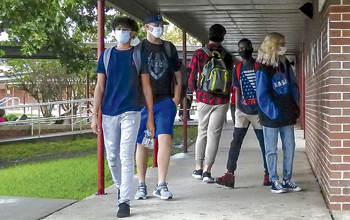
ALACHUA COUNTY – Beginning May 4, Alachua County Public Schools’ Food and Nutrition Services Department began providing free suppers and snacks for children age 0-18 at 29 school sites throughout the district. This is in addition to the free breakfast and lunch meals currently provided at 78 schools, community centers and bus stops in Alachua County.

Distribution of the additional meals continue through May 29. That will be the last day of school for Alachua County Public School students, based on Governor Ron DeSantis’ announcement that schools would remain physically closed but continue with distance learning until their originally-scheduled closing date.

The extra meals are being provided through the Afterschool Meals Program, which is a part of the federal government’s Child and Adult Care Food Program. Typically, the program is used to provide nutritious snacks and meals to children in after-school programs. However, the district recently received federal approval to distribute the extra meals at some of its existing meal distribution sites.

The additional meals and snacks will be distributed Monday through Thursday from 11 a.m. to 1 p.m. at the sites listed below. The suppers and snacks are available free to all children 0-18, and they do not have to be enrolled at the school to take advantage of the program.

The sites at which suppers/snacks will be provided are:

Alachua Elementary

Foster Elementary

Lincoln Middle

Shell Elementary

Archer Elementary

Glen Springs Elementary

Meadowbrook

Talbot Elementary

Bishop Middle

Hidden Oak Elementary

Metcalfe Elementary

Terwilliger Elementary

Buchholz High

High Springs Community

Newberry Elementary

Wiles (Snack Only)

Chiles Elementary

Idylwild Elementary

Norton Elementary

Williams (Snack Only)

Duval Early Learning Academy

Irby Elementary

Oak View Middle


Eastside High School

Lake Forest Elementary

Rawlings Elementary


Finley

Littlewood Elementary

Reichert House


A full list of the sites providing breakfast, lunch, supper and snacks is available at www.yourchoicefresh.com and on the district’s COVID-19 page at www.sbac.edu.

#     #     #

Email editor@

alachuatoday.com

Add a comment

HIGH SPRINGS – The High Springs City Commission unanimously approved an agreement between the City and Oak Ridge at High Springs Homeowners’ Association (HOA) after prolonged arguments over required repairs to Phase Two of the subdivision.

HOA President and developer Rick Howe submitted a punch list for Phases One and Two for $3,450 and $23,043, for work remaining on the project. These amounts are significantly lower than the original amount of remaining work, which was estimated to be approximately $98,000 in late 2018.

The agreement significantly guarantees that the work will be completed, and with the belief that Howe intends to build out the remaining phases of the subdivision, the Commission agreed to authorize the signing of the contract.

As security for the performance of the agreement and on behalf of Oak Ridge HOA, within 45 days Howe Development Corporation is expected to deposit the full cost of completing the punch list work totaling $26,493 into the Trust Account of Salter Feiber, P.A., counsel for Howe Development Corporation.

Regarding Phase Two, Feiber will notify the City when the deposit is made into the trust account. In the event the cost to bring the infrastructure improvements into compliance with City regulations exceeds the amount specified, the City shall bear no responsibility for the cost of completing the work. In the event Oak Ridge HOA defaults in the performance of this agreement, the funds remaining in the trust account shall be held by Salter Feiber and subject to dispersal by the City to complete the work.

Within 60 days of the date of the agreement, Oak Ridge HOA is to provide the City with an executed contract with a licensed and qualified contractor for the work to be performed.

The construction contract necessary to complete the work shall be assignable to the City and the funds in the trust account are to be available to the City if Oak Ridge HOA fails to complete the work.

The City agreed that no permit is required for the work.

In exchange, the City will allow the HOA to file the application to install signage and lighting at the Phase Two entrance similar to the signage and lighting previously approved and installed at the entrance to Phase One. The expense to install and maintain the signage is the responsibility of the Oak Ridge HOA.

Once the work has been completed as specified the City will accept and maintain the right-of-way in Oak Ridge Phase Two and all improvements including, but not limited to the roads, sidewalks, water and sewer.

#     #     #

Email cwalker@

alachuatoday.com

Add a comment

ALACHUA COUNTY – The world remains in the grip of the COVID Pandemic, with over three million cases worldwide and 213,824 deaths as of April 28. The United States has one-third of all cases, with over a million confirmed infections and 58,412 dead.

Over a period of three months, people watched their lives and routines change. Social activities involving any group greater than 10 disappeared, schools closed their doors and many work places shut down causing 26.5 million people to lose their jobs. Throughout the nation, the most effective way to slow the spread was to self-quarantine, staying at home while only going out for essential errands and even then, staying at least six feet from anyone else.

But the social isolation has brought about negative effects as well. Besides the economic toll, many people are having a hard time dealing with the stress and constant close quarters by families for an extended period of time.

Some states and the Federal government want to start reopening the nation, but if not done in steps and in conjunction with increased testing and scientific development, reopening could cause a resurgence, which could lead to a wider infection spread, higher death rate and a longer quarantine.

The Federal government has suggested a three-phase reopening based on declining infection rates and increased testing, but has also left it up to each state to determine when it is safe to do so. This has led to a wide range of steps by different governors. Some, such as Georgia's Bryan Kemp and Las Vegas Mayor Carolyn Goodman are trying to open as soon as they can, ignoring much of the first two phases and advice from medical experts. Others are taking a more cautious and measured approach, and each state is forming their own plan.

Florida Governor Ron DeSantis is announcing his plan to begin Phase 1on April 30, possibly beginning as early as May 1 when the three-week-old state lock down expires. This is also the date President Trump has referenced several times, although most medical experts are concerned it may be too soon.

Phase 1 is not much different than the current guidelines. All groups over 10 are still prohibited, schools and bars will remain closed. However, larger venues like restaurants, movie theaters, gyms and churches can reopen as long as they adhere to health and distancing standards.

“I think for Florida, going from where we are now to Phase 1 is not a very big leap,” DeSantis said. “We’re going to approach it in a very measured, thoughtful and data-driven way, and I think that’s what most of the folks throughout the state are looking for.”

Florida ranked 8th as to number of cases in the United States. On Tuesday morning, April 28, Florida had 32,846 cases, 1,171 deaths, and 5,222 hospitalizations. While the cases continue to increase, public health experts say Florida has successfully reined in the coronavirus outbreak and is ready to slowly start reopening if certain public health measures are kept in place to prevent the virus from spreading again, and needs to quickly increase its testing. To date, Florida has tested 357,075 individuals, which is about one for every 60 people. The majority of the cases have been concentrated in Southeast Florida.

Out of the 32,846 cases in Florida, 1,049 are in North Central Florida, with the State confirming 255 cases in Alachua County. Alachua County has the most cases of the counties in the North Central Florida region. Out of 255 cases, 100 are men and 144 are women and range in age from two – 94. Hospitalization has been required in 44 percent of all cases and two people in Alachua County have died from the COVID-19 virus. However, the death rate for Alachua County is less than 1 percent while the state average is 4 percent.

#     #     #

Email rcarson@

alachuatoday.com

Add a comment

NEWBERRY – The City of Newberry has rescheduled the City’s regular municipal election from April 14 to Aug. 18 this year. During the April 27 meeting Commissioners unanimously approved a Proclamation changing the date. Due to the COVID-19-related order for people to stay home, Commissioners decided to postpone the election in an effort to keep citizens safe during the pandemic.

The qualifying period already occurred from noon on Monday, March 2 to noon on Thursday, March 12, 2020, and the candidates that qualified at that time are the candidates for this election.

The proclamation also expands the voting location to include Precinct 4, which is located at Newberry United Methodist Church, 24845 W. Newberry Road, and to Precinct 6, the Newberry Municipal Building, 25420 W. Newberry Road.

This year’s election will decide three spots on the City Commission, Groups One, Two and Three. Currently, all elected commissioners will serve two-year terms.

In Group One, City Commissioner Ricky Coleman is running unopposed. Mark L. Clark and Joy Glanzer are facing off in Group Two and incumbent Monty Farnsworth faces challenger Walt Boyer in Group Three.

Also on the ballot are proposed City Charter revisions and changes in terms of service for the Mayor and Commissioners.

Polls will open at 7 a.m. close at 7 p.m. on Aug. 18. The Clerks, Deputy, and Inspectors of Precinct 4 and Precinct 6 will be assigned by Alachua County Supervisor of Elections Kim Barton.

The final day of registration for the City of Newberry municipal election will be 5 p.m. on Monday, July 20, 2020.

#     #     #

Email cwalker@

alachuatoday.com

Add a comment

HIGH SPRINGS – The City of High Springs is developing a Competitive Florida Partnership Program grant submittal to the Department of Economic Opportunity (DEO) later this year.

If the submission is successful, the program will award High Springs a $40,000 grant to fund the creation of a strategic economic plan that promotes community design, economic diversity, economic viability and disaster resiliency. The program also offers a committed partnership with DEO to provide long-term technical assistance.

When the City originally sought the grant, funds were limited and High Springs was initially shut out. However, upon learning that additional funds had been funneled into the program, DEO representatives contacted High Springs about submitting again.

Planning, engineering, and design consulting firm Kimley-Horn has been commissioned to conduct community meetings and develop a draft and final Economic and Disaster Resiliency Plan for submission on behalf of High Springs.

During the April 23 City Commission meeting, Kimley-Horn Planner Alyssa Monaghan presented a slide deck presentation to provide an overview of the community meetings that have taken place so far, which have resulted in a draft Economic and Disaster Resiliency Plan.

The program’s goal is, “To help Florida communities find creative solutions to foster vibrant, healthy communities while protecting the functions of important State resources and facilities.”

The April 23 City Commission meeting is considered the fourth community meeting out of five that is to be conducted prior to submitting the plan. The first meeting was held Jan. 15 and focused on economic development. The second took place Feb. 20 with a focus on disaster preparedness. The third, which was held March 9, focused on community assets. Following this City Commission meeting, a fifth community meeting will be held May 14 to review the final plan and seek plan adoption by the City Commission prior to submission.

Monaghan recapped visions of the community that were developed during meeting two. “High Springs is a charming, quaint community with a unique history, and genuine people.” In addition, “High Springs strives for well planned growth, with focus on business development, employment expansion, ecotourism, affordable housing, and various educational opportunities while maintaining its one-of-a-kind identity.”

The plan that Kimley-Horn has developed is a stepping stone to actually making these things happen. The presentation listed several of the tools and actionable projects that the City and the public have to take in order to implement the plan. A summary of those projects is listed below.

The City recently submitted their Evaluation and Appraisal Report letter to the Florida Department of Economic Opportunity (FDEO) on April 7. The City is now required to update its Comprehensive Plan by April 7, 2021.

Once the Comprehensive Plan has been updated, the City must also update their Land Development Code (LDC) within one year. A primary focus at that time will be to update its Development Review Process.

As part of the plan, the City is expected to expand their communication efforts. Relatively low-cost ways in which that might be accomplished is by expanding the content of the City’s website, creating a City Hall Facebook page, increasing the use of Twitter and expanding knowledge of the Nixle App for citizens to receive emergency/community updates. She said these actions are a way to reach out to the community and keep them engaged in City activities, events and updates.

Another aspect of the plan is for the community to work with the Department of State, Division of Historical Resources to preserve the City’s historical buildings.

A program should be developed to provide homebuyer education and down payment assistance. Assisting residents to find affordable housing and the ability to invest in the city is an important part of the plan. The City is encouraged to create a program to educate interested citizens on home buying and ownership.

Another aspect of the plan is to compile and maintain documentation of available industrial and commercial real estate buildings and sites within High Springs. The list should be maintained on the City’s webpage for potential site selectors.

Monaghan also suggested the City build regional partnerships with North Central Florida Regional Planning Council, Alachua County, and the cities of Gainesville, Newberry and Alachua.

Kimley-Horn Engineer Amanda Lunday, E.I., addressed the Disaster Resiliency component of the plan. “Disaster recovery relies on the public’s involvement,” she said.

Recommendations include interagency, regional and local planning capacity and cooperation. That involves data-sharing, identification of and mapping areas and people at higher risk and establishing protocols for better coordination.

A good public education program should be in place and citizens and business owners should be engaged in the process. This also involves encouraging businesses to develop their own resiliency plan as part of stakeholder involvement. The City could host or encourage appropriate agencies to host public education sessions on disaster preparedness as one way to accomplish that goal. “Also, the creation of a hybrid Community Emergency Response Team might be another aspect of that,” said Lundy.

#     #     #

Email cwalker@

alachuatoday.com

Add a comment

ALACHUA COUNTY – Increasing mosquito populations and mosquito breeding are occurring. The Florida Department of Health in Alachua County (FDOH-Alachua) would like to remind residents and visitors the importance of protecting yourself by taking the following steps:

  • Drain water from garbage cans, house gutters, pool covers, coolers, toys, flowerpots, or any other containers where sprinkler or rainwater has collected.
  • Discard old tires, drums, bottles, cans, pots and pans, broken appliances, and other items that aren't being used.
  • Empty and clean birdbaths and pet's water bowls at least once or twice a week.
  • Protect boats and vehicles from rain with tarps that don't accumulate water.
  • Maintain the water balance (pool chemistry) of swimming pools. Empty plastic swimming pools when not in use. Repair broken screens on windows, doors, porches, and patios.
  • Those who must be outside when mosquitoes are active, cover-up. Wear shoes, socks, long pants, and long sleeves.
  • Use netting to protect children younger than two months.
  • Cover doors and windows with screens to keep mosquitoes out of your house.Repair broken screening on windows, doors, porches, and patios.

Tips on Repellent Use

  • Always read label directions carefully for the approved usage before you apply a repellent. Some repellents are not suitable for children.
  • Products with concentrations of up to 30 percent DEET (N, N-diethyl-m-toluamide) are generally recommended. Other U.S. Environmental Protection Agency-approved repellents contain picaridin, oil of lemon eucalyptus, para-menthane-diol, or IR3535. These products are generally available at local pharmacies. Look for active ingredients to be listed on the product label.
  • Apply insect repellent to exposed skin or onto clothing, but not under clothing.
  • In protecting children, read label instructions to be sure the repellent is age-appropriate. According to the Centers for Disease Control and Prevention (CDC), mosquito repellents containing oil of lemon eucalyptus should not be used on children under the age of three years. DEET is not recommended for children younger than two months old.
  • Avoid applying repellents to the hands of children. Adults should apply repellent first to their own hands and then transfer it to the child's skin and clothing.
  • If additional protection is necessary, apply a permethrin repellent directly to your clothing. Again, always follow the manufacturer's directions.

For more information on mosquito-borne diseases, visit the Florida Department of Health and the Centers for Disease Control and Prevention websites.

FDOH-Alachua and local mosquito control continue surveillance and prevention efforts throughout the county. Report mosquito problems to your municipality's mosquito control or the Florida Department of Health in Alachua County at 352-334-7930.

#     #     #

Email editor@

alachuatoday.com

Add a comment

NEWBERRY – The Newberry City Commission conducted a virtual commission meeting on April 27 via Zoom and YouTube. Viewers were able to comment and two individuals were sworn in so they were able to give testimony in relation to annexation matters on the agenda.

The commission held public hearings on second reading of 11 voluntary annexation requests. Twenty-two parcels of land, consisting of some 634 acres, were approved. The annexations serve to either eliminate an existing enclave or fill in finger enclaves that currently exist according to the City’s Planning and Economic Development Director Bryan Thomas.

As is standard practice, a letter notifying the Alachua County Board of County Commissioners was sent to the board’s chair on Feb. 27, declaring the City’s intent to annex these parcels.

Although most of the annexation ordinances were easily approved, Thomas explained that City Manager Mike New received an April 8 letter from County Manager Michele Lieberman expressing concern over properties in four of the annexation ordinances, specifically Ordinances 2020-04, 2020-06, 2020-09 and 2020-10.

During the Commission meeting, each of the ordinances was addressed in order and all were approved. Thomas had the opportunity to discuss the four disputed annexations as they arose.

“Ordinance 2020-04 pertains to a 19.4-acre parcel located on Southwest 250th Street and south of Southwest 46th Avenue. It is surrounded on the north by unincorporated parcels, east and west by City of Newberry parcels, and on the south by both unincorporated and municipal parcels,” Thomas said.

The second annexation of concern by the County is incorporated in Ordinance 2020-06. That ordinance pertains to two parcels with a total of 13.17-acres. The parcels are located north of Southwest 15th Avenue, between Southwest 202nd and 226th Streets.

In both cases, the City is attempting to shrink existing enclaves, something Alachua County had previously asked the City to do. Thomas addressed each of the County’s concerns and also pointed out that while Florida State Statutes prohibit the creation of enclaves through voluntary annexation, they do not address the diminishment of existing enclaves into smaller enclaves through voluntary annexations.

The third ordinance in question is Ordinance 2020-09, which pertains to a single 80-acre parcel. The parcel is located north of State Road 26 (Newberry Road), between Dudley Farms State Park to the west and Northwest 170th Street to the east.

The County’s concerns are that the property is not substantially contiguous, not compact and creates a pocket enclave. County's staff's opinion is that “the proposed annexation appears to result in the creation of an unincorporated ‘pocket’ which is inconsistent with the statutory definition of ‘compactness.

The County staff report cites the potential for inefficiencies in service delivery and land use conflicts, and that the only access to the parcel appears to be off of SR 26 via Northwest 182nd Street, which is an unpaved private drive. The City of Newberry Agriculture land-use category is similar to the County’s Rural/Agriculture land use designation and also limits residential development to one unit per five acres.

“Currently, municipal water service is over 1.6 miles and wastewater service is over three-miles to the west. In the absence of municipal water and wastewater availability, the City’s comprehensive plan prohibits urban development at any higher density, therefore the potential for land-use conflicts is minimal,” Thomas said. “As for road access, the parcel is also directly accessible by private drive from Northwest 170th Street, across a 31-acre parcel owned by the same family, and which has already been annexed into the City of Newberry. As to the potential for inefficiencies in service provision, the annexation will in no way affect access of the unincorporated parcels in the remaining ‘pocket’ to any County services,” he said.

The fourth annexation, Ordinance 2020-10, pertains to five parcels with a total of approximately 284 acres. The parcels are located on the east side of Northwest 202nd Street and south of Northwest 46th Avenue. The County’s concern stems from their view that the land is not contiguous with the municipal boundary, that there is a lack of “reasonable compactness” and that a portion of the annexation is only contiguous between two adjoining corners.

The County staff report cites the potential for inefficiencies in service delivery and land-use conflicts. Currently, municipal water and wastewater service is more than four miles from the proposed annexation area. “In the absence of municipal water and wastewater availability, the City’s comprehensive plan prohibits urban development at any higher density therefore the potential for land use conflicts is minimal,” Thomas said. “As to the potential for inefficiencies in service provision, the annexation will in no way affect access of the surrounding unincorporated parcels to any County services.”

Newberry City Attorney Scott Walker said, “There is a body of law that point-to-point corners of property are not sufficient under annexation law to provide contiguity.” He also pointed out that since this property was not encompassed in an enclave, the argument that the City is attempting to close an enclave would not be available to the City.

Mayor Jordan Marlowe countered that this is not two separate parcels, but one parcel with the same tax parcel number. He also said he believed he could make that point to the Alachua County Commission.

Although Walker advised that this issue, if challenged, would not survive the challenge in his estimation, Commissioners voted unanimously to approve the ordinance on second reading.

Thomas said he plans to set up a meeting between City and County staff to attempt to address their concerns and resolve issues.

The next City Commission meeting is scheduled for May 11.

#     #     #

Email cwalker@

alachuatoday.com

Add a comment

More Articles ...